
🛸 Sci-Fi & Cyberpunk
Quick Summary
Sci-Fi & Cyberpunk is a theme exploring future hardware technology settings, focusing on the impact of technical science, mechanical design, and artificial intelligence on the environment and society. It identifies a setting directly opposed to the traditional Fantasy theme.
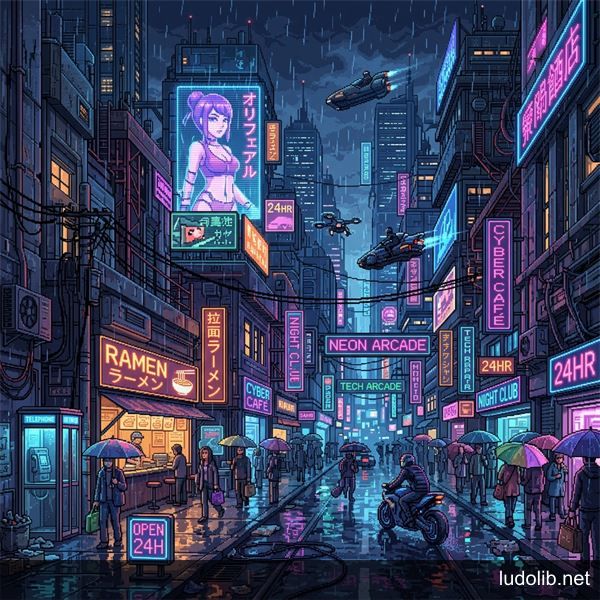 Illustration: Characteristic visual design of a Cyberpunk setting with urban super-architecture, Neon lighting technology, and dense industrial environments.
Distinct from the Fantasy theme, which inherently uses supernatural magical elements, the design system in Sci-Fi/Cyberpunk game environments revolves around simulating imagery based on mechanical engineering advancements, space exploration, and biotechnology rooted in physical or pseudoscientific foundations.
1. Sci-Fi (General Science Fiction)
The foundation of the broad Sci-Fi format often focuses on resolving macro settings like faster-than-light space travel, extraterrestrial colonial spaces, or the autonomy of artificial intelligence (AI).
- Mechanistic systems (Game Mechanics) are operated by visual technological models instead of magic. Example: Plasma energy guns, force field particle shields, or tactical biological protective armor.
- Art Direction mostly prioritizes a clean futuristic style, utilizing many metallic geometric lines, spacecraft structures, and reflective surfaces (Glossy Sci-Fi) or the pragmatic rust of bunkers (Industrial Sci-Fi). Typical games like Mass Effect or Halo clearly illustrate military technology confrontation and shared space civilization.
2. Cyberpunk
As a specific derivative branch of Sci-Fi, Cyberpunk narrows the scope to a single internal societal model with a contrasting core design philosophy: “High Tech, Low Life”.
- Spatial Setting: The context is usually confined to stifling mega-cities secretly controlled by megacorporations. Characteristic gameplay elements revolve around the mechanic of implanting mechanical microchip components (Cybernetics/Chrome) directly into the character’s body, creating system intervention capabilities and physical enhancements.
- Visually, typical games like Cyberpunk 2077 use a defining lighting system with highly saturated neon colors, vertically stratified urban architecture, and dirty wet surfaces. This rendering trend also often requires a massive amount of optical reflection computational resources (Ray-Tracing) for executing hardware like GPUs.
Interactive Design Characteristics
The design philosophy of the sci-fi theme group demands significant budget for building virtual materials (Concept UI/UX) to recreate technologies that have never existed in real life, such as 3D holographic displays (Holographic/Diegetic UI) and network decoding operations. It creates a very distinct cinematic experience space serving the user group passionate about directed information technology.