
🎯 Osu!
“Rhythm is just a click away.” — Unofficial motto of the Osu! community
Basic Information
| Developer | Dean “peppy” Herbert (individual → ppy Pty Ltd) |
| Release Year | 2007 |
| Genre | Arcade & Rhythm |
| Platform | Windows, macOS, Linux, Android, iOS |
| Business Model | Free-to-play, open-source |
1. What is Osu!?
Quick Summary
Osu! is a free and open-source video game in the rhythm game (Rhythm game) genre on personal computer platforms. The core characteristic of this software is a library of music beatmaps, the vast majority of which are contributed by the community.
Osu! was developed and managed as open-source content by Australian programmer Dean Herbert (nicknamed “peppy”) in 2007. The application’s original prototype was a simulation clone of the Japanese tap-rhythm game Osu! Tatakae! Ouendan for the Nintendo DS. However, it eventually evolved into an independent platform capable of unlimited library expansion through user-generated content (Beatmaps). This characteristic built a stable online ecosystem contributing tens of thousands of interactive music data files to the application each year.
2. Game Modes
This is the most unique aspect of Osu! compared to other rhythm games — one platform containing 4 completely different gameplay mechanics:
🎯 osu! Standard (Original Mode)
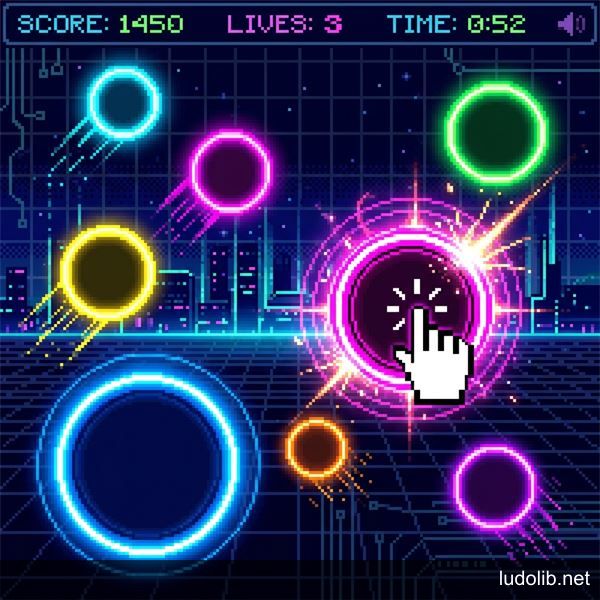
Use a mouse/pen tablet to click on circles (Hit circles) and follow sliders in time with the music. This mode requires the highest level of coordination between eyes, hands, and reflexes.
🥁 osu!taiko (Taiko Simulation)
Simulates Taiko no Tatsujin — hitting the drum in rhythm with two types of notes (Don/Katsu). Many users play this mode to practice before approaching real arcade machines.
🍎 osu!catch (Fruit Catching)
Control a character running left and right to catch falling fruit in time. The simplest mechanics of the 4 modes, but requires extremely fast reflexes at high speeds.
⌨️ osu!mania (Keys)
Similar to Guitar Hero or DJMAX — press corresponding keys as note bars fall to the limit line. The number of key columns can range from 4 to 9, serving players from beginner to expert.
3. What Made Osu! a Phenomenon?
Community-Created Beatmaps
Osu! doesn’t sell music DLC — instead, any player can create their own beatmap for any song and upload it to the shared server. The Ranked/Approved/Loved system categorizes beatmap quality through a community review process.
This is a User-Generated Content (UGC) model before that concept became mainstream — similar to how Steam Workshop works today.
Performance Points (pp) and Ranking System
Osu! has a complex achievement scoring system called pp (Performance Points), calculated based on beatmap difficulty, accuracy, and combo. The global Leaderboard creates enormous competitive motivation — a textbook application of Feedback Loop in game design.
Real Skill Training
The pro gaming community uses Osu! to train aim (precision aiming) for FPS games like CS2 and Valorant. This transforms Osu! from a casual game into a serious training tool.
4. Osu! and the Indie Game Industry
The Osu! story is living proof that an individual with open-source software can build a community of millions without a studio or large budget — one of the most successful cases of the indie game movement in the early internet era.
See also: Taiko no Tatsujin, Guitar Hero, Beat Saber, Geometry Dash, Arcade & Rhythm