
🎸 Guitar Hero
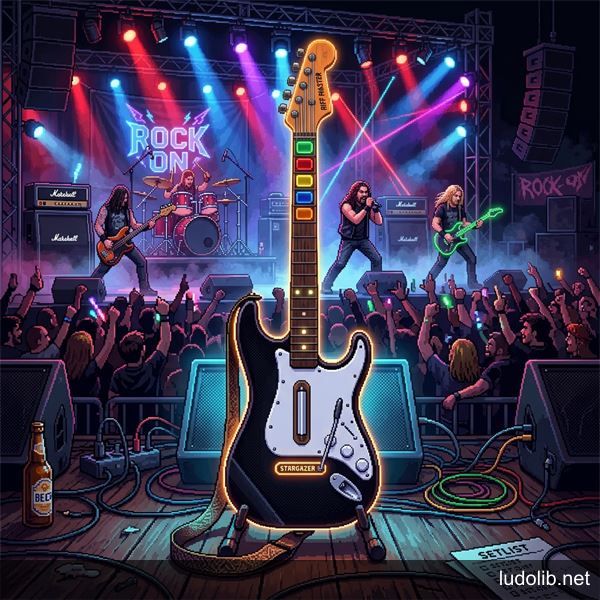
“You don’t need to know how to play a real guitar. But after playing Guitar Hero, you’ll want to learn.”
Basic Information
| Developer | Harmonix (GH1-2) → Neversoft (GH3-Warriors of Rock) → FreeStyleGames (GH Live) |
| Publisher | RedOctane → Activision |
| Release Year | 2005 (PS2) |
| Genre | Arcade & Rhythm |
| Platform | PS2, Xbox 360, PS3, Wii, PC, Mobile |
| Defining Feature | Guitar-shaped controller with 5 colored buttons |
1. What is Guitar Hero?
Guitar Hero is a game franchise using a miniature guitar-shaped controller with 5 colored buttons (Green, Red, Yellow, Blue, Orange) on the neck and a strum bar on the body. Players strum at the right moment as colored notes scroll down on screen — synced to guitar riffs in a playing rock song.
Released in 2005 by Harmonix (before they created Rock Band) and published by RedOctane, Guitar Hero quickly became a mass cultural phenomenon in the US and worldwide.
2. Core Mechanics
The 5-Color Note System
This is a simple but genius mechanic: 5 colored buttons corresponding to 5 fingers on the guitar neck. Players hold the colored button + strum simultaneously as the note hits the “Strike Zone”. The base mechanic can be learned in 5 minutes but mastering Expert difficulty requires hundreds of hours — the perfect definition of “Easy to learn, hard to master”.
Star Power
One of the most interesting Dynamics: accumulate “Star Power” by playing special note sections correctly, then tilt the controller up to activate it — doubling the score for a period of time. This mechanic encourages both physical action and tactical decision-making (when to use Star Power).
The Rock Meter
A continuously updated accuracy gauge. If too many notes are missed, the Rock Meter hits 0 and the virtual audience on stage throws items at you — game over. The “audience reaction” mechanic creates extremely compelling Stage Aesthetics.
3. Why is Guitar Hero a Historical Milestone?
Opening the “Peripheral-based games” Market
Guitar Hero proved that consumers are willing to pay more to get specialized controllers for a specific experience. This model was later expanded by Rock Band (adding drums, microphone), DJ Hero (DJ decks), and many others. This is a major lesson in the hardware-software bundle monetization model.
Cultural Effect on Real Music
After Guitar Hero’s release, electric guitar sales in the US shot up. Many studies showed the game was a bridge bringing a new generation to classic rock music — Through the Fire and Flames by DragonForce (the hardest song in GH3) remains a cultural symbol of extreme difficulty to this day.
The Collapse and Business Lesson
In 2010, Activision released too many Guitar Hero versions in too short a time, saturating the market and ultimately killing the entire Franchise. This is a classic case study of franchise fatigue in the game industry.
→ Read more: History of Video Games
4. Influence on Later Generations
- Rock Band (2007, Harmonix): Expanded Guitar Hero into a full band with drums, bass guitar, and microphone.
- Clone Hero (2017): A free PC version created by the community, allowing players to play thousands of custom songs. Thriving in the community to this day.
- Guitar Hero Live (2015): Attempted a revival with a 6-button controller and the GHTV streaming system — ultimately unsuccessful and $300M was written off.
See also: Taiko no Tatsujin, Osu!, Beat Saber, Geometry Dash, Arcade & Rhythm