
🚀 Shoot ‘em Up (Shmup / Bullet Hell)
Quick Summary
The core anatomy of the shooting game genre, Shoot ‘em up controls a spaceship/character firing back at waves of enemies flooding the screen. In its most extreme form called Bullet Hell — where players must focus on weaving through dense carpet patterns created by thousands of bullets.
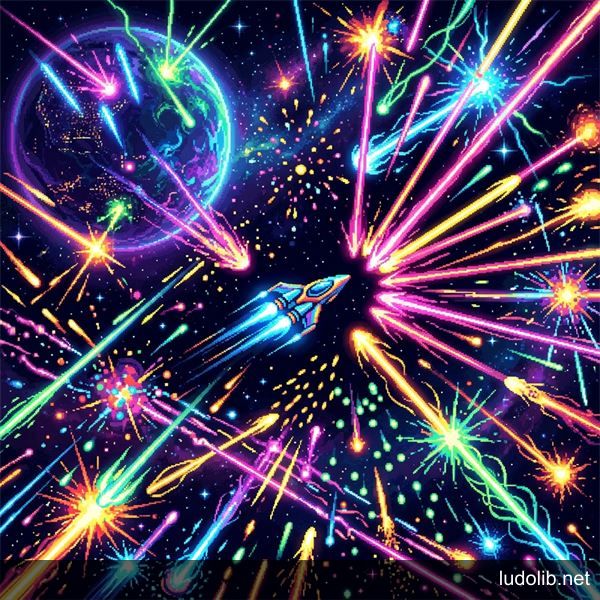
Shoot ‘em up (commonly abbreviated as Shmup) is the foundational prototype demonstrating reflex skill structure in games using directional and projectile attack keys. The game assigns the individual the authority to continuously navigate a single body unit (typically a spaceship) against a sweeping attack system from enemies raining screen-filling bullets.
During the most extreme design phases of displayed damage intensity, this system is further categorized and specifically named Bullet Hell, or by its original Japanese name Danmaku (Bullet Curtain).
Operational Design Anatomy
- Micro Hitbox: The risk operating core for Bullet Hell lies in the resolution of the physical touch point metric (Hitbox). While a spaceship model may be visually 20px wide across the display, the risk evaluation collision size is typically compressed down to just 1 center pixel at the belly. Enemies can fire tens of thousands of bullets grazing your wings — but as long as you avoid letting bullets touch the core center zone, you’re safe.
- Mathematical Frequency Pattern (Pattern System): The way main boss bullet streams are launched never carries a random structure. Trajectories use fractal arc-pattern movement streams and Mandala structures to challenge visual quantitative analysis of blank space.
- Scroll Direction: The spatial perspective typically divides the environmental space into two main display systems: top-down scrolling and side-scrolling surface navigation.
Historical Design Milestones
- Touhou Project: An independently published foundation that created the most famous internal-culture generation of the Bullet Hell industry. Notable for multi-media design activity centered on background music composed by original author ZUN.
- Space Invaders / Galaga: System structures marking historical milestones generated on traditional Arcade cabinet interfaces from the late 1970s.
- Ikaruga: A design project with the characteristic of changing traditional risk learning standards. The color-switching absorption analysis of bullet stream colors transforms the navigation layer into color pairing rather than purely dodging.
- Cuphead: An architectural layer primarily oriented toward Boss-rush structure, with design features reflected through bullet patterns designed entirely following Bullet Hell pattern laws.
Interaction Capability Management
- The game genre typically requires sensitive reflex device capability with a flexible Analog stick system taken from the Analog pad design of Controller systems.
- Shmup doesn’t cover static environmental scenes. The emphasis is on the technical parameter scripting process embedded by engineers (Game Designer) using multi-spiral Sine/Cosine mathematical equation pattern code to establish continuously complex bullet density and trajectories displayed in image space.