
🪣 Prop Design in Games
TL;DR: Prop Design is the process of designing and producing objects (items, equipment, decorations) in the game world — from an ordinary wooden barrel to the protagonist’s iconic weapon. Good props don’t just look beautiful — they tell stories, support gameplay, and create a consistent material language for the entire game world.
A room in a game with no props is just an empty box. Props are what transform empty space into a world that breathes — a messy work desk reveals the owner’s personality, scattered barrels tell players this is a warehouse, a rusty weapon on the floor tells the story of a past battle. This is the intersection of Environmental Storytelling and 3D Modeling Pipeline.
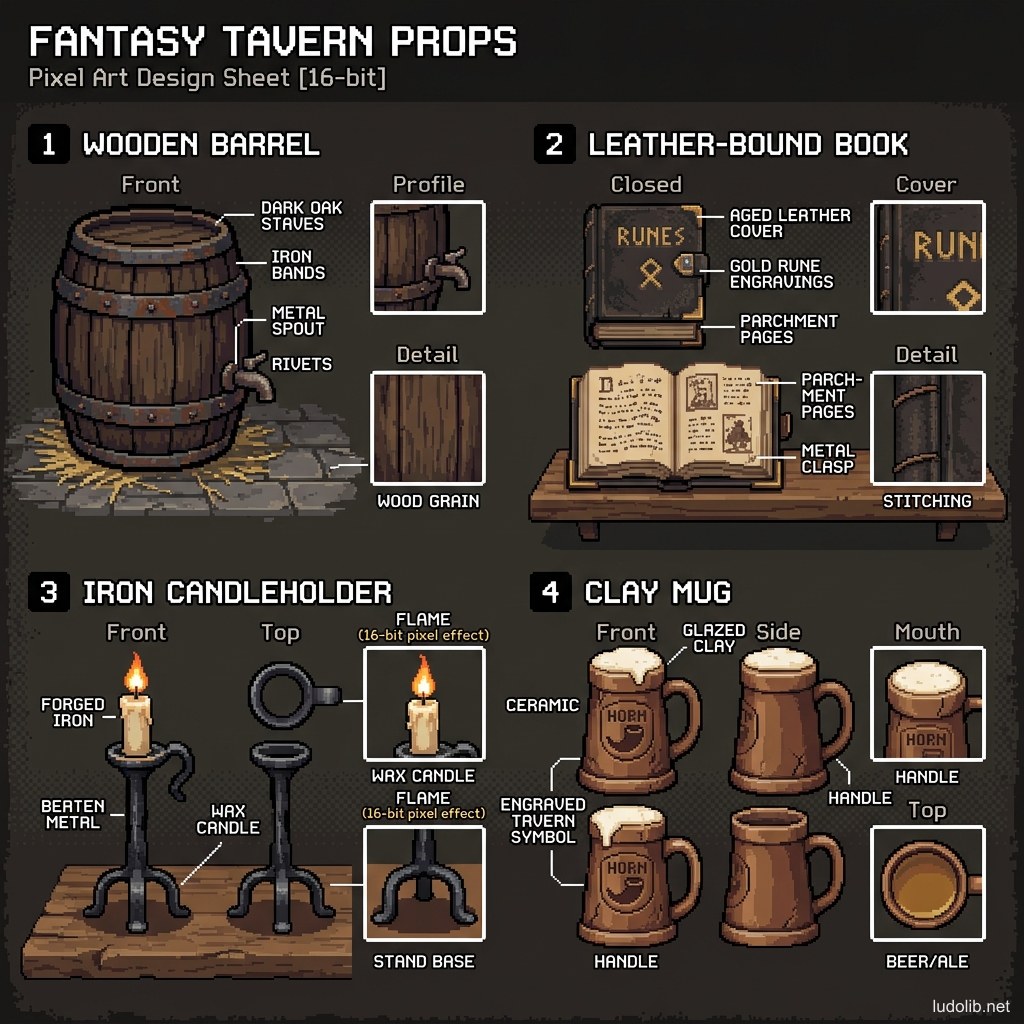
Core Concepts
| Prop Type | Definition | Example |
|---|---|---|
| Hero Prop | Important object seen up close, needs high detail | Protagonist’s weapon, key plot item |
| Secondary Prop | Common object, medium detail | Tables, chairs, barrels, doors |
| Background Prop | Only seen from a distance, low LOD | Distant power poles, background trash cans |
| Interactive Prop | Player can interact with (pick up, break, pull) | Pushable boxes, levers, keys |
| Dressing Prop | Decoration only, not interactable | Picture frames, flower pots, artwork |
Operating Principles
Material Language
Prop Design is not just about shape — materials carry social and cultural messages [S1]:
- Refined wood, polished metal → Wealthy, civilized
- Rotting wood, rusty iron → Poor, abandoned, dangerous
- Intricately carved stone → Ancient, religious, mysterious
- Uniform-colored metal with organic design → High-tech, Sci-fi
A fantasy game like Dark Souls distinguishes social class through props alone: nobleman’s room has glass chandeliers and velvet curtains, peasant’s room has straw and wooden buckets.
Silhouette Readability for Props
Like characters, props also need immediately readable silhouettes — especially for Interactive Props that players need to recognize quickly in gameplay [S2]:
- Pickable items: Glowing aura, distinctive shape
- Breakable objects: Fragile-looking material, physical suggestion (wooden barrel vs. stone wall)
- Pullable objects: Clear handle/grip, interactive suggestion
Prop Library and Modular Design
Large studios build Prop Libraries — reusable object collections. Rather than creating each object fresh for every room, artists combine from existing modules: barrel A + lid B + rope C = new cargo container. This technique significantly reduces production time [S3].
Game Examples
- Dishonored (Arkane Studios, 2012) — Props designed in a “Whale-punk” set — technology powered by whale oil. Every prop from streetlights to machinery has oil pipes, steam valves, and consistent copper-yellow coloring — creating a world with its own material logic.
- Stardew Valley (ConcernedApe) — At indie pixel art scale, props (farming tools, furniture, items) are designed with extremely readable silhouettes at 16x16 pixel size — a much greater challenge than 3D.
- Dark Souls (FromSoftware) — “Prop as lore” — every item in the game comes with a description (item description) revealing world history. A rusty sword is not just a weapon — it’s a chapter of lore.
Trade-offs
| Aspect | Content |
|---|---|
| ✅ Advantages | Reusable Prop Library significantly reduces production time. Modular design allows infinite variations from few components. |
| ❌ Disadvantages | ”Asset Fatigue” — using too many identical props without variants makes the world feel fake (identical barrels in every room). |
| ⚠️ Common Pitfall | Overdetail Hero Props — investing too much detail in unimportant props wastes polygon and texture budget that players don’t notice. Clearly categorize Hero/Secondary/Background from the start. |