
🏆 eSports
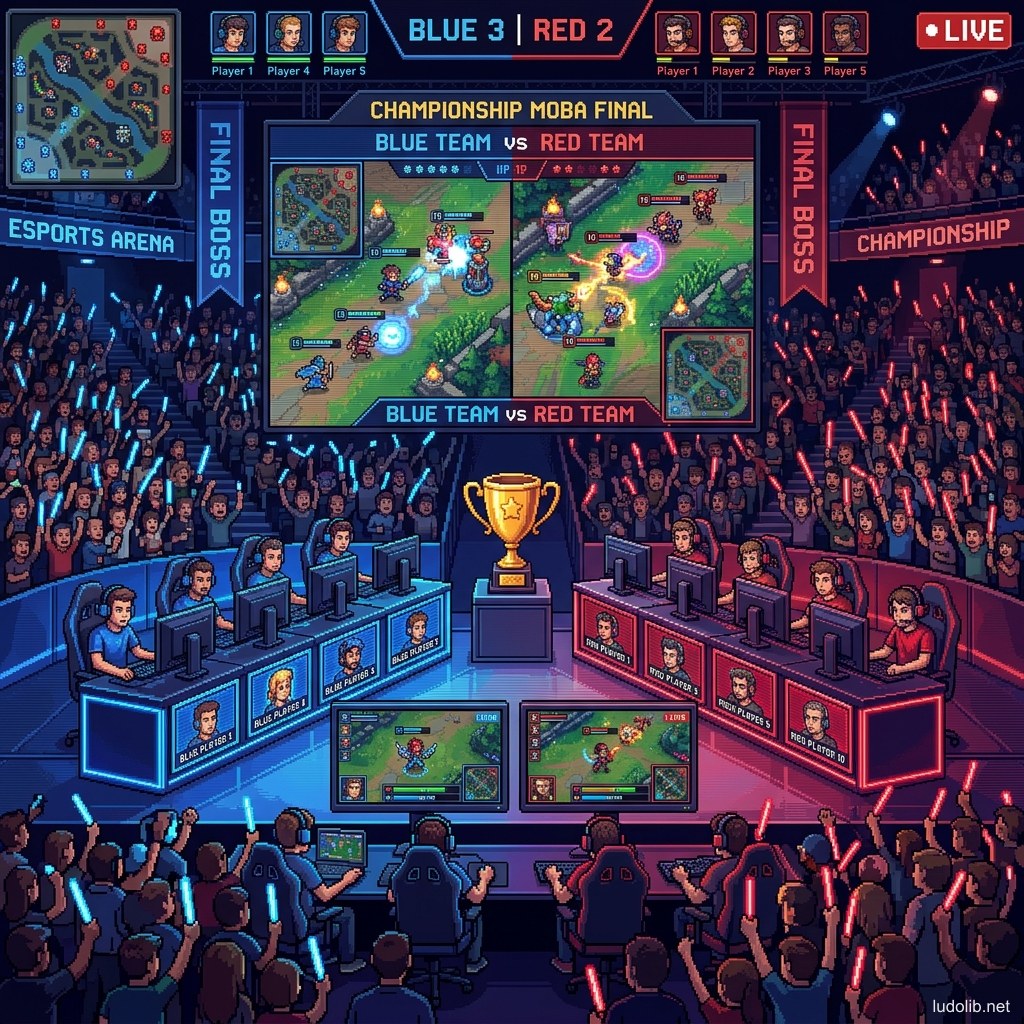 Illustration: The blazing atmosphere of an eSports stadium with tens of thousands of spectators and two professional teams competing in MOBA on the center stage.
Quick Summary
eSports (Electronic Sports) is a term referring to organized, competitive forms of video gaming, typically hosted at concentrated event venues and broadcast at a professional scale with clear hierarchical scoring mechanisms.
Detailed explanation: The eSports ecosystem transforms the definition from ordinary entertainment into a direct professional service-oriented competitive event mechanism. Publishers and developers establish tournaments applying unified regulatory structures to stratify competitive rankings for teams, attracting commercial conglomerate investment with specialized broadcasting systems equivalent to mainstream physical sports. As of 2024, the total global operational scale reached a financial participation milestone valued at $1.8 billion USD.
History
The Dawn (1972–1990)
The first historically recorded organized game tournament was the Space Invaders Championship hosted by Atari in 1980, attracting over 10,000 participants across the United States. Before that, in 1972, Stanford University organized the Spacewar! tournament — the first competitive gaming event in history.
The Internet & LAN Party Era (1990–2004)
The advent of high-speed internet and online games like Quake (1996), StarCraft: Brood War (1998), and Counter-Strike (1999) laid the foundation for competitive online gaming culture. South Korea became the eSports capital of the world — the OGN television channel began broadcasting StarCraft tournaments in the late 1990s, turning progamer into a socially recognized profession.
The Twitch & MOBA Era (2010–Present)
The launch of Twitch.tv (2011) revolutionized how fans follow eSports. MOBA titles like League of Legends and [[Dota|Dota 2]] exploded:
- The International 2021 ([[Dota|Dota 2]]): Record prize pool of $40 million USD — funded by the fan community.
- LoL World Championship 2022: Held in San Francisco with 5.1 million simultaneous viewers globally.
Popular eSports Game Genres
| Genre | Notable Examples | Competitive Characteristics |
|---|---|---|
| MOBA | League of Legends, [[Dota|Dota 2]] | 5v5, team tactics |
| FPS/TPS | CS2, Valorant, Overwatch | Reflexes, aim, tactics |
| Battle Royale | PUBG, Apex Legends, Fortnite | Survival, positioning, looting |
| RTS | [[StarCraft|StarCraft II]], Age of Empires IV | Micro/macro, high APM |
| Fighting | Street Fighter 6, Tekken 8 | 1v1, reading opponent, combos |
| Sports | FIFA/EA FC, Rocket League | Traditional sports simulation |
| Card Game | Hearthstone, Legends of Runeterra | Deck building, tactics |
Ecosystem Structure
Sponsor → eSports Organization (Team Org)
                    ↓
        Professional Player (Pro Player)
                    ↓
        Tournament / League
                    ↓
    Spectator → Ad revenue / Betting revenue
- Riot Games operates the LCS, LCK, LEC for League of Legends — a closed franchise league model.
- Valve organizes The International via an open qualifier model with a Battle Pass-funded prize pool.
Pro Player Requirements
A professional pro player needs:
- Mechanics: Character control skills and reflexes at the highest level (APM > 300 in RTS).
- Game Sense: Map reading, predicting opponents, strategic decisions.
- Mental Fortitude: Ability to perform under pressure before tens of thousands of spectators.
- Physical Fitness: 8–12 hours of training/day, preventing wrist and eye injuries.