
⚽ Team Sports
Quick Summary
Team Sports groups games simulating sports like football, basketball, hockey — requiring players to have good spatial thinking ability, know how to manage formation overviews, and coordinate smoothly between multiple virtual members.
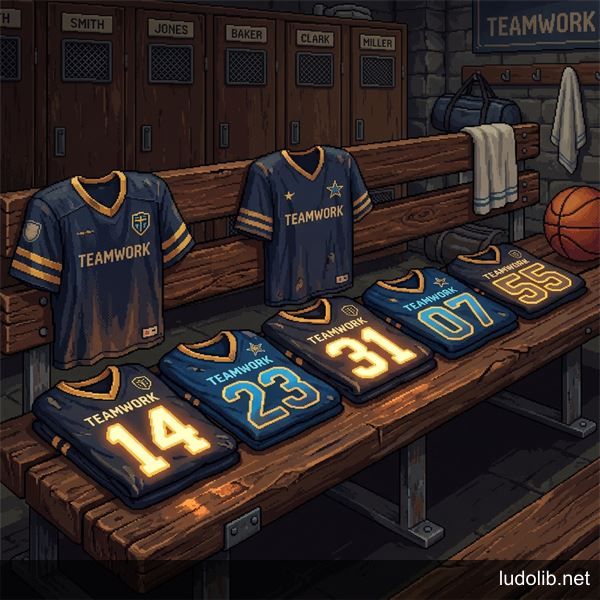
The Team Sports category serves as a classification framework for the entire design area of games simulating practical competitive sports based on the principle of multi-personnel mutual athletic coordination (such as Football, Basketball, Hockey, or American Football).
Difference Between Digital Physics Application and Real-World Active Sports
- Continuous Context-Switching: If real-world professional competition requires 1 individual to be closely tied to 1 specific position, then in game systems, users must multitask with multiple streams. While operating a dribble along the wing one second, players must via system navigation (Switch Player) immediately identify and transfer control authority to the central player entity to create a through-ball link at the precise instant in the wide field of view (Bird’s-eye-view).
- The team activity linking mechanic overwhelmingly loads the individual with having to calculate hundreds of variable positions — both for the ball-receiving player and for the inertia momentum of the ball’s sensitive bounce when physically contacting air resistance forces. Elevating the application capability from entertainment target to an extreme-intensity cognitive cycle of “Multi-directional measurement and simultaneous multi-stream reflexes.”
Global Standard-Level Representative Systems
- FIFA (Republished under the EA Sports FC name): The peak-scale product structure defining the continental-level commercial franchise sports game revenue ecosystem with billions in exploitation sources. Maintains a long-running reflection mechanism alongside historical competitive opposition like the authenticity franchise contrast module in the physical pitch space of Pro Evolution Soccer - PES.
- The basketball classification framework of North America possesses an explosive expansion development cycle with monumental legacy scale in the NBA 2K structural platform.
Distribution Cycle Revenue
Beyond the physical form parameter simulation level, Team Sports system operation belongs to a highly heavy re-displacement structure for revenue risk recovery types by applying game monetization with continuous annual releases. The Gacha interaction creates card-opening variation of randomized player stat groups (Ultimate Team Cards) applied to the player motivation drain cycle — with alternating adjustments to apply an annually revolving payment structure after a new season updates surface parameters while inner architectural strength rarely changes.