
Real-Time Strategy (RTS)
Quick Summary
Real-Time Strategy (RTS) is a strategy genre branch where players must gather resources, construct bases, and command armies to defeat opponents in a continuously flowing time stream — with no concept of turn-based waiting.
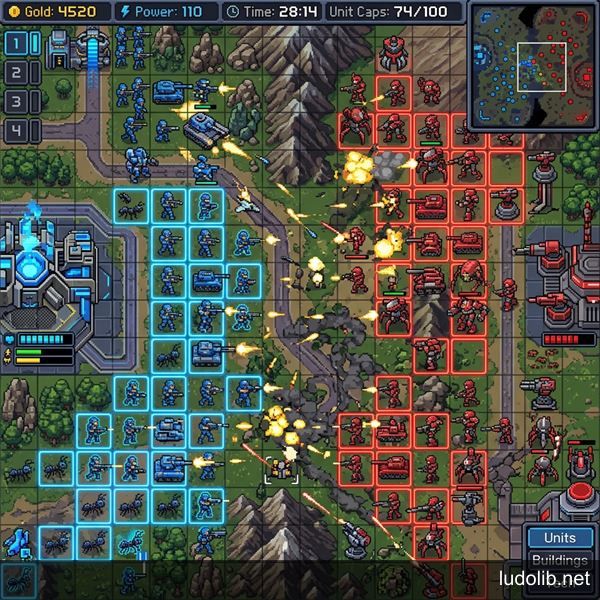 Illustration: Typical unit-level micro-control interface of RTS games, where users navigate tactics through click-select operations on the battlefield interface.
The RTS genre frames the experience around the ability to process multi-task information. Unlike the slow deliberate thinking of Turn-Based Strategy, RTS forces the player’s decision-making process to occur in parallel with the depletion of the real-time chart.
Basic Operating Structure
A basic development cycle (Core Loop) in RTS typically includes several synchronously running activity branches:
- Resource Gathering: Setting up worker units or automated extraction systems to harvest biological/inorganic minerals on the map. Resource gathering speed determines the economic potential for warfare.
- Base Building: Allocating resources to construct buildings, creating tech chains (Tech-trees) to unlock higher-tier soldiers.
- Micromanagement (Micro): The skill of navigating individual soldier units (Pulling weakened soldiers back, activating special skills, dodging directed attacks).
- Macromanagement (Macro): Overall strategic vision (Expanding the map, allocating harvest points, controlling camera screen area).
Operation Density and Technical Requirements
The algorithmic characteristic of RTS establishes a capability measurement milestone called APM (Actions Per Minute). Famous games like [[StarCraft|StarCraft II]], Age of Empires, or [[Warcraft|Warcraft III]] require competitive eSports players to maintain APM levels from 300 to 400 to continuously switch command streams between different bases within the same second. Due to continuous mouse cursor interaction requirements, the RTS structure operates most optimally on the Mouse & Keyboard PC platform combination.
See Also
→ Full article: Real-Time Strategy