
🤖 AI in Games (Artificial Intelligence)
Quick Summary
AI in Games refers to the scripted systems and algorithms that control the automated behavior of enemies, NPCs, and other game entities — simulating intelligent responses to player actions. More recently, Generative AI is beginning to transform how game content is created.
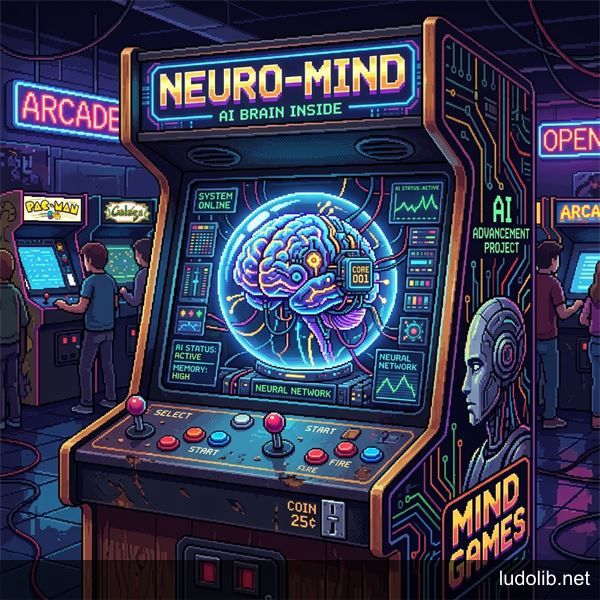
The authenticity of any virtual world depends entirely on how “intelligent” its machines appear — sophisticated enough to fool the player’s perception of reality.
1. Traditional AI: State Machines & Pathfinding
Unlike Machine Learning, most enemy AI in games is a pre-scripted behavior tree computed by sequential logic:
Pathfinding (A* Algorithm)
How does a monster navigate around rocks without getting stuck to chase the player? Pathfinding is the most fundamental AI task in games — the A* algorithm finds the shortest valid path between two points through a navmesh grid.
Finite State Machine (FSM)
A behavior pattern defining how an NPC transitions between states:
- Patrol State: Moving along a predefined route
- → Hears sound → Alert State: Moving toward sound source
- → Sees player → Attack State: Engaging the player
The sophistication of this behavior tree creates the perception of “smart vs. dumb AI.” Famous examples: the Covenant AI in Halo, the FEAR AI in F.E.A.R. (still praised as one of the most sophisticated game AI systems).
Behavior Trees
A more modern alternative to FSMs — hierarchical tree structures that can handle complex, conditional AI behaviors with greater modularity. Used in Halo Infinite, Unreal Engine AI systems.
2. Generative AI Era (Modern)
The rise of Large Language Models and Neural Networks is beginning to permanently change game development:
- Dialogue Generation: AI generating infinite branching NPC dialogue in real-time. Players can speak into a microphone to a random NPC and receive contextual responses (instead of pre-selected text lines).
- AI Upscaling (DLSS): Graphics cards render at lower resolution, then AI neural networks predict missing pixels to upscale to 4K sharpness without real computational cost (see Anti-Aliasing).
- Procedural Content: AI generating infinite levels, quests, and world details.
- AI-Assisted Development: Tools like GitHub Copilot accelerating code writing; AI generating texture variations and 3D mesh details.
AI in games is blurring the boundary between human-authored content and machine-generated interactive experience.