
🔍 Anti-Aliasing
Quick Summary
Anti-Aliasing (AA) is a graphics technique that smooths the jagged “staircase” edges that appear in rendered 3D images. It is one of the most fundamental image quality settings in any game.
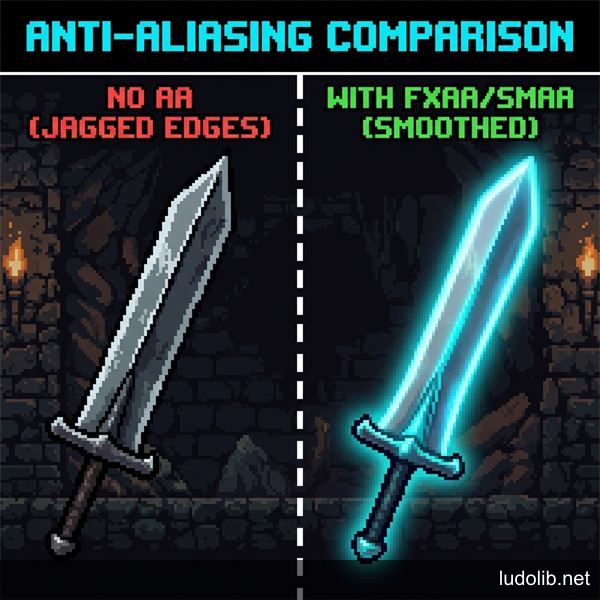
The Problem: Aliasing
When a diagonal or curved edge is drawn on a grid of square pixels, the approximation creates visible “jaggies” — a staircase-like artifact at the boundary between colors. This is called aliasing.
AA Techniques
| Method | Quality | Performance Cost | Notes |
|---|---|---|---|
| MSAA (Multi-Sample AA) | High | High | Traditional; GPU-intensive |
| FXAA (Fast Approximate AA) | Medium | Very Low | Post-process blur; cheap but slightly blurs the image |
| TAA (Temporal AA) | High | Medium | Uses previous frame data; can cause ghosting |
| DLSS (Deep Learning SS) | Excellent | Low* | Nvidia AI upscaling; renders at lower res, upscales |
| FSR (AMD FidelityFX SS) | Good | Low* | AMD’s DLSS alternative; works on all GPUs |
| XeSS (Intel) | Good | Low* | Intel’s AI upscaling solution |
DLSS: AI-Powered Anti-Aliasing
DLSS (Deep Learning Super Sampling) by Nvidia represents a revolution in AA — the game is rendered at a lower resolution (e.g., 1080p), then an AI neural network upscales it to 4K with remarkable quality. This provides both AA and resolution enhancement while improving FPS.