
🖼️ Sprite Renderer
Quick Summary
Sprite Renderer is the core 2D rendering component in game engines. Its primary function is to load a digital image file (PNG, JPEG) and render it onto a 2D coordinate plane of the display. It is the fundamental building block of all 2D game graphics.
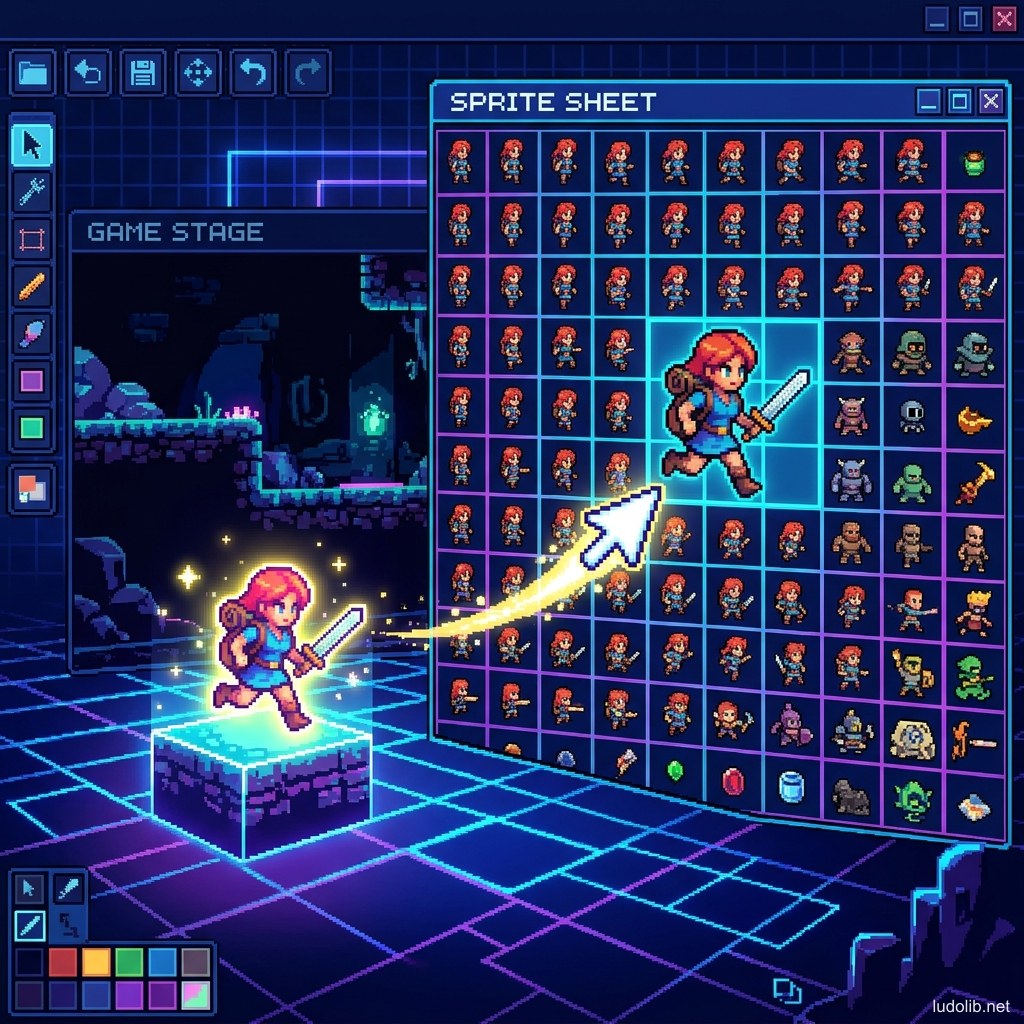
How Flat Rendering Works
When a Sprite Renderer component is initialized, the system does not parse the object as a 3D model (with depth, volume, or polygon structure). The renderer only receives color data (pixel data) in a 2D coordinate system (X and Y axes).
Surface processing pipeline: The renderer applies orthographic projection, continuously outputting pixel data to the screen each frame (see FPS (Frames Per Second)).
Importantly, images produced by Sprite Renderer have no physical properties. For a 2D character to interact with the environment (standing on ground, affected by gravity), programmers must attach additional mathematical components like Box Collider 2D (collision system) and Rigidbody 2D (physics simulation).
Spritesheets and Animation Rendering
In practice, loading individual image files for each animation pose (one image for running, one for jumping) would exhaust bandwidth and RAM through continuous file I/O. The industry solution is the Spritesheet technique:
- Data grouping: All animation frames for a character are packaged into a single large image file.
- Slicing: The Sprite Renderer is programmed to calculate and cut this large image into a coordinate matrix grid.
- Sequential rendering: Instead of loading new files, the renderer rapidly flips through Spritesheet coordinate windows (e.g., 12 frames/second), creating the visual illusion of continuous movement.
The Spritesheet technique combined with Sprite Renderer is the critical optimization enabling indie projects and retro-style games to display rich animation within extremely limited RAM budgets.