
💡 Ray Tracing
Quick Summary
Ray Tracing is a rendering technique that simulates the physical behavior of light — tracing the path of light rays as they bounce off surfaces — to produce photorealistic shadows, reflections, and global illumination.
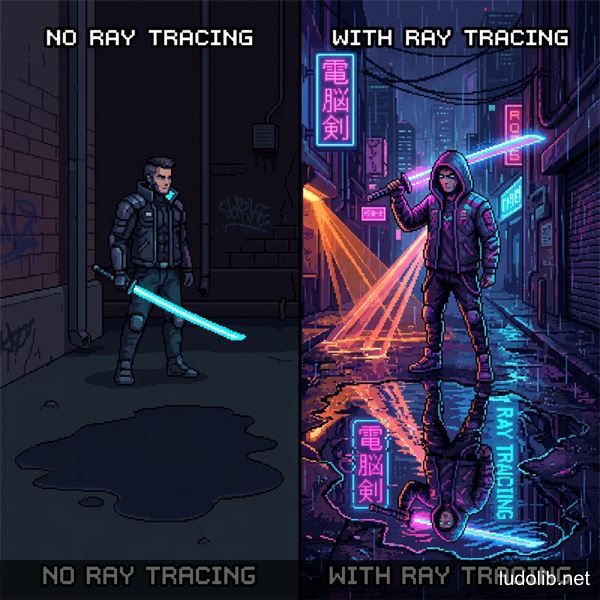
How Traditional (Rasterization) Rendering Works
Conventional real-time rendering (used since the 1980s) uses rasterization: project 3D geometry onto a 2D screen, then approximate lighting through tricks (baked shadows, cube map reflections, normal maps). Fast but inherently approximate.
How Ray Tracing Works
Ray tracing simulates actual light physics:
- For each pixel, fire a virtual “ray” from the camera into the scene
- When a ray hits a surface, trace new rays toward light sources (shadows), reflections, and refractions
- The accumulated light data gives physically accurate color for that pixel
This produces:
- Accurate reflections (mirrors, water, polished metal)
- Physically correct shadows (soft, size-varying)
- Global illumination (light bouncing from surfaces, color bleeding)
Performance Cost
Ray tracing is computationally expensive — each pixel requires hundreds of ray calculations. Nvidia’s RTX GPU series introduced hardware-accelerated ray tracing (RT Cores) in 2018, making real-time ray tracing in games feasible.
Current State (2024)
Most games use hybrid rendering: rasterization for most geometry + ray tracing selectively for reflections, shadows, or AO. Full path tracing (e.g., Cyberpunk 2077 “Ray Tracing Overdrive”) requires very high-end hardware.