
🦴 Forward Kinematics (FK)
Quick Summary
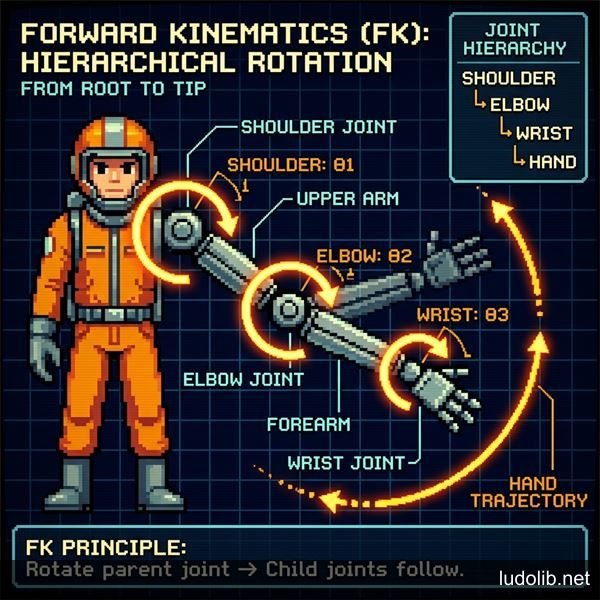
Forward Kinematics (FK) is the standard method of skeletal 3D animation — where the animator manually poses each bone in a hierarchy from parent to child, and child bones inherit the transformations of their parent bones.
The Bone Hierarchy
In 3D character animation, a character’s body is defined by a skeleton rig — a hierarchy of bones:
Root (Hips)
├── Spine
│   ├── Chest
│   │   ├── Left Shoulder → Left Upper Arm → Left Forearm → Left Hand
│   │   └── Right Shoulder → Right Upper Arm → Right Forearm → Right Hand
│   └── Head
├── Left Thigh → Left Knee → Left Ankle → Left Foot
└── Right Thigh → Right Knee → Right Ankle → Right Foot
How FK Works
In FK, transformations flow from parent to child:
- Rotate the Spine bone → Chest follows
- Rotate the Chest → Shoulders follow → Arms follow → Hands follow
The animator controls each bone’s rotation directly. This gives precise artistic control but requires manually posing every bone in a chain.
FK vs IK
| Forward Kinematics | Inverse Kinematics | |
|---|---|---|
| Control direction | Parent → Child | End effector → Parent |
| Use case | Broad body motion, walk cycles | Foot/hand contact with surfaces |
| Artistic control | High (manual) | Calculated automatically |
| Real-world feel | Requires skill | More physically natural |