
🦾 Inverse Kinematics (IK)
Quick Summary
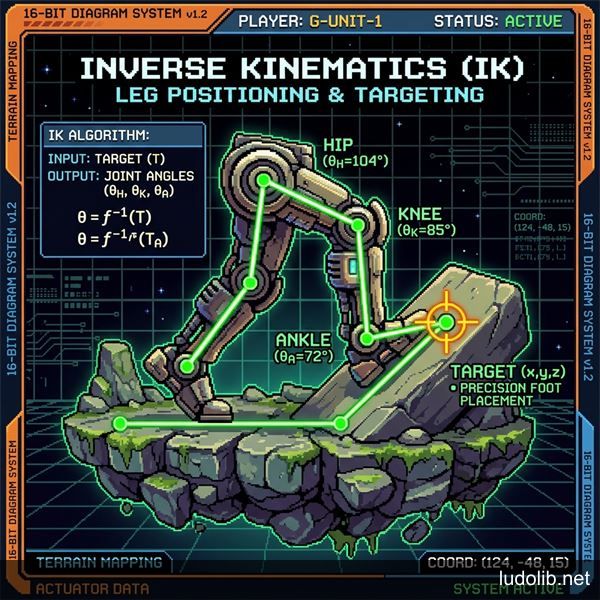
Inverse Kinematics (IK) is a computational animation method where the animator specifies a target position for the end of a bone chain (e.g., the hand), and the IK solver automatically calculates the angles of all parent bones needed to reach that position.
The Problem IK Solves
In Forward Kinematics, a character’s hand is placed by manually rotating every bone in the arm chain. But what about placing a hand precisely on a door handle, or making a character’s feet contact uneven terrain naturally?
IK solves this elegantly: define where the end effector (hand, foot) should be, and the IK solver computes all intermediate bone angles automatically.
IK Applications in Games
Foot Placement (Most Common)
Characters walking on uneven terrain (stairs, slopes, rocks) use foot IK to plant feet naturally on surfaces, instead of floating or clipping through geometry.
Hand-Object Interaction
Grabbing a lever, pressing a button, picking up an item — IK ensures the hand lands precisely on the object regardless of the character’s pose or position.
Head Look-At
Characters turning to look at the player or a point of interest use IK to rotate the head and spine toward a target naturally.
Full-Body IK (FBIK)
Modern systems like Unreal Engine’s Control Rig and Unity’s Animation Rigging package allow full-body IK — the entire body adapts to target positions.