
🌪️ Player Journey Funnel
Quick Summary
The Player Journey Funnel is a core business model that helps publishers track and optimize the lifecycle of a gamer — from the moment they first hear the game’s name until they become high-spending “brand advocates.” The funnel consists of 6 narrowing stages: Aware User → Player → Active Player → Paying Player → Whale → Advocate. Each stage requires entirely different intervention instruments and metrics. [S1]
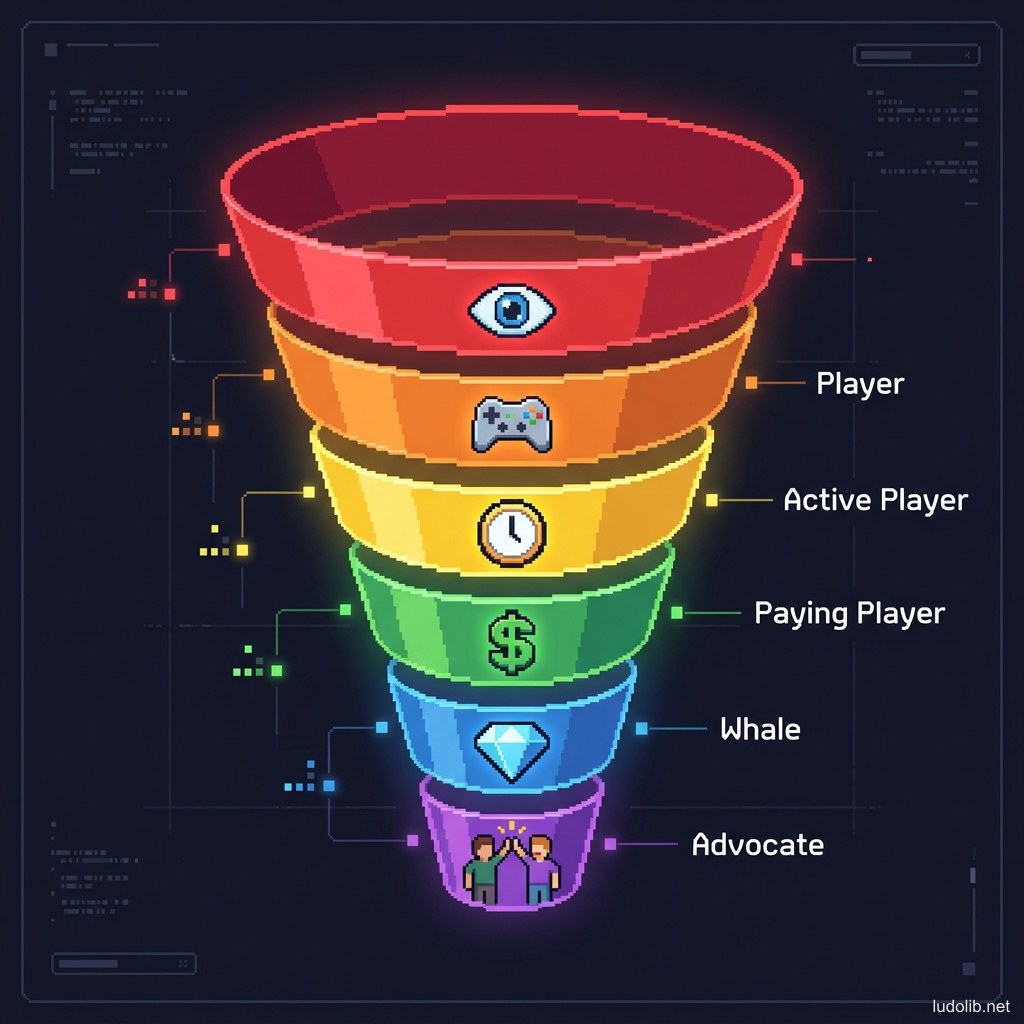 Illustration: The 6 stages of the Player Journey Funnel, with each narrowing tier representing the natural churn at each conversion step.
A successful game needs more than just good gameplay — it needs a marketing and live-ops engine to push players deeper down the funnel. Below is a detailed breakdown based on Anton Slashcev’s framework [S1].
1. Top of Funnel: Acquisition and Onboarding
This stage focuses on volume: capturing as many eyeballs and installs as possible.
👁️ 1. Aware User
A user who is aware of the game but hasn’t played it yet.
- Instruments: Ads, Video Creatives, Social Media, Influencer Marketing.
- Key Metrics: Impressions, Click-Through Rate (CTR), Ad recall.
🎮 2. Player
A user who has downloaded, installed, and started playing the game.
- Instruments: ASO (App Store Optimization), User-friendly Onboarding (see: FTUE Casual Games).
- Key Metrics: Install rate, Tutorial completion rate.
2. Middle of Funnel: Retention and Conversion
This stage determines whether the game survives. The steepest drop-off (churn) occurs here.
🕒 3. Active Player
A player who regularly engages with the game.
- Instruments: In-game events, Daily rewards, clear Progression.
- Key Metrics: DAU/MAU (Daily/Monthly Active Users), Playtime, Retention rate (D1, D7, D30).
💸 4. Paying Player
A player who has made at least one in-game purchase. Converting from “free-to-play” to “paying” is the hardest psychological barrier to break.
- Instruments: IAP (In-App Purchase) options, Special offers (e.g., starter packs), Exclusive content.
- Key Metrics: Conversion rate, ARPU (Average Revenue Per User), Purchase frequency. Read more about strategies at Game Monetization Models.
3. Bottom of Funnel: Core Revenue and Virality
The bottom of the funnel contains the smallest number of users but generates 80-90% of total revenue and provides immense organic marketing value.
💎 5. Whale
A player who spends significantly more than the average on the game. They are the lifeblood of Free-to-Play games.
- Instruments: VIP programs, Personalized offers, Premium content.
- Key Metrics: LTV (Lifetime Value), ARPPU (Average Revenue Per Paying User), High-value transaction rate.
🤝 6. Advocate
A player who is highly engaged and actively promotes the game to others. They act as free, highly trusted marketing engines.
- Instruments: Referral programs, Community features, Social mechanics.
- Key Metrics: Referral rate, User-generated content volume (fanart, videos), Social media mentions.
4. See Also
- Game Monetization Models — Business models applied throughout the funnel
- Retention — The most critical metric for the Active Player stage
- LTV and CAC — Two vital metrics for evaluating the overall efficiency of the funnel
- FTUE Casual Games — The key to converting an Aware User into a Player
- Community Management — How to nurture the Advocate base
References
- [S1] Anton Slashcev, “Player Journey Funnel” — Executive Producer Infographic (2024)