
🕵️ Mystery & Detective
Quick Summary
Mystery & Detective focuses on the process of gathering clues, connecting data points, and using logical analysis to solve cases or clarify complex storyline elements. The core focus of this genre is placed on rational deductive reasoning rather than mechanical operation and fast reflexes.
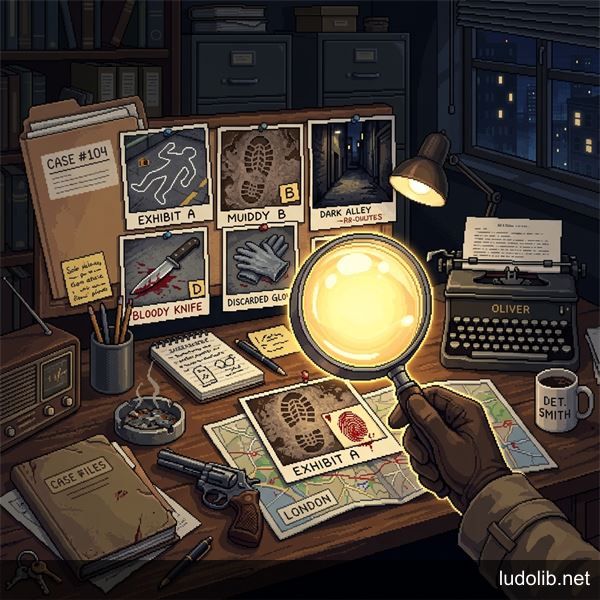 Illustration: The characteristic working structure of the detective genre, where players arrange networks of cross-referenced data and evidence to reconstruct an incomplete sequence of events.
Contrary to the structure of most action games, the Mystery & Detective format minimizes pressure on hand-operation speed (Reflexes/APM). This is a game group prioritizing event analysis and problem-solving abilities. The core loop typically begins with the system providing an incomplete volume of information, requiring the user to inspect, evaluate, and reassemble evidence to recreate the truth of a case or a sequence of events.
Investigation Mechanics
The process of participating in an investigation is built on several basic interactive foundations:
- Interrogation: Players navigate a multiple-choice dialogue tree to gather information from suspect NPCs. The challenge level of this mechanic depends on finding loopholes in the answers through hypothetical profiles. An example of technology supporting this mechanic is the game L.A. Noire (2011), which used Motion Capture technology to capture facial movements, providing micro-data on the authenticity of character expressions.
- Cross-Examination: Very popular in the Japanese-style visual novel game structure like Ace Attorney or Danganronpa. The puzzle mechanic requires users to directly cross-reference collected samples (evidence, notebooks) to argue against specific testimony items, thereby refuting a chain of logically flawed causal arguments.
Deductive Reasoning Design: Return of the Obra Dinn
The game Return of the Obra Dinn (2018), designed by an independent developer (AAA vs Indie), clearly illustrates a new design direction for the Detective branch. This work provides users with a tool capable of freezing time at the exact moment of a target’s death, through reports displayed in static 3D space combined with muffled environmental noise. The mechanical task is to cross-reference over 60 portraits with a manifest list to accurately determine the identity, cause of death, and modus operandi of each individual on an independent transport vessel.
This continuous logical grid structure arrangement creates a mechanic loop demanding intense deductive reasoning focus, laying a reference foundation for design segments belonging to the Story-Rich group.