
✈️ Space & Flight Sims
Quick Summary
Space & Flight Sims remove superficial combat formats to become professional digitized curricula. They require players to operate cockpit instrument panels identical to reality, endure real air resistance coefficient pressure, and even the physics of zero-gravity zones.
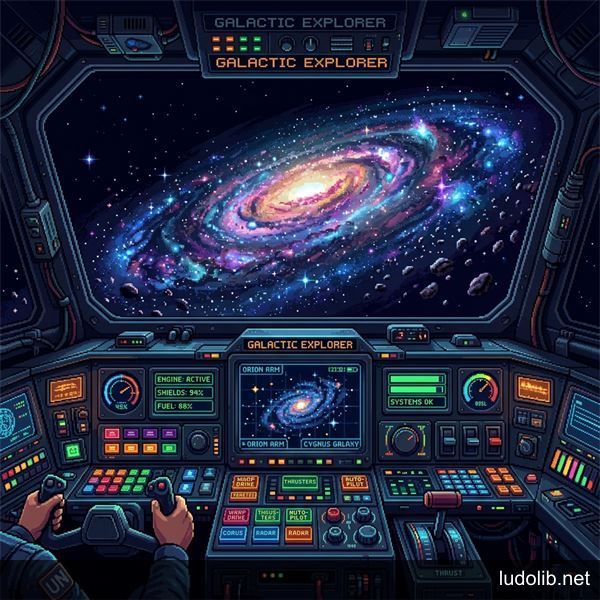
The Flight / Space Simulator classification group moves the control environment far from ground boundaries to place the experiencer in an aerodynamic interaction system of a standard flight simulation system. Unlike the fast-rhythmic aiming function of the Shoot ‘em up sub-branch, this classification concentrates its strength on the high-degree specialized detailed simulation level of interior cockpit circuit panels and practical air pressure resistance physics.
Foundational Branch Structure
1. Flight Simulator (Atmospheric Aircraft Coordination)
Serving as digitized resource systems used for practical simulation training curricula.
- The process of simulating commercial or military aircraft coordination requires actual checklist-level process loops: the process of activating derivative energy pumps, measuring communications, and marking standard air traffic control systems occurs for extended periods before the vehicle achieves air resistance.
- The risk parameter measurement set undergoes resistance and disruption from weather coefficients (crosswind resistance, fog pressure drop points) configured with standard cross-section altitude ratio divisions of the Earth’s terrain.
- Global historical regeneration work: Microsoft Flight Simulator (2020). The brand applies Bing Maps aviation map access volume simultaneously loading weather stream parameters through cloud computing. The project recreates a 1:1 geographic geometric data volume through massive AI-based redrawing processing technology — leading to the highest-level operational capacity demands from GPU & Gaming Hardware image retrieval systems.
2. Space Simulator (Cosmic Space Exploration Simulation)
Expands functions in the physical environment reflecting the absence of aerodynamic pressure (Zero-G).
- Operational mechanisms rely especially on Newtonian momentum physics system steering. Without the pull-back force of the atmospheric environment, deceleration acceleration requires a direct auxiliary reverse rocket push angle.
- Large-scale spatial link expansion works typically provide hypothetical realistic economic intersection structure standards like unconstrained mine exploitation laws or wide-area naval warfare.
- Fantasy structure projects: Elite Dangerous and the massive borderless open-ended expansion platform Star Citizen — reflecting the trend of project teams recreating extreme-quality cosmic universe graphics by processing millions of particle node measurement entities on elemental-level analysis engine foundations. And simulation stream games like Kerbal Space Program — targeting a discrete orbit-merging physics simulation configuration under rocket acceleration physics online load.
Technology Connections
The tight weight steering replication characteristic leads to the formation of an industrial ecosystem building and producing exclusive peripheral hardware device groups for force-direction (HOTAS/Flight Stick). The device mechanic system has become a tool applied to virtual reality structure with the foundational flight simulation environment system for theoretical flight training. To closely track micro-parameter real-time measurement systems and display interference resistance levels, this is the strictest reference system serving as the benchmark for testing the capability of multi-spatial parameter simulation environment applications on the core development team’s Game Engine configuration foundation.