
👁️ God-view
Quick Summary
God-view (Omniscient perspective) is a camera perspective design method placing the display viewpoint from high above overlooking the ground. It grants the player the power to manipulate and observe the entire area on a macro role.
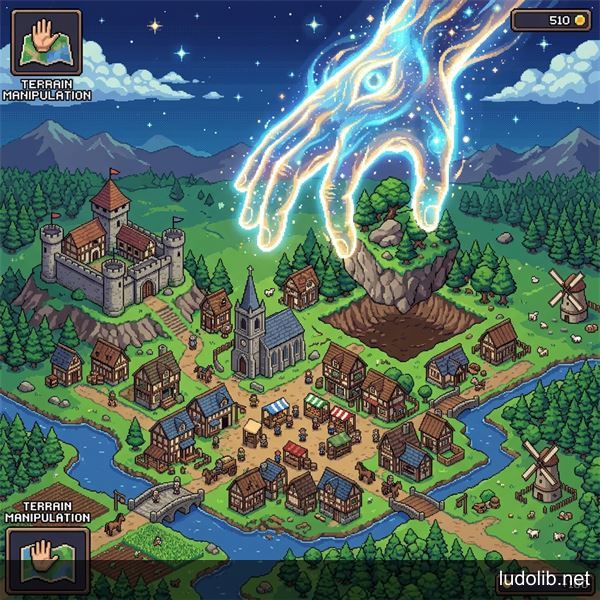 Illustration: The power structure of a God-game, where the player interacts with a subordinate ecosystem through a comprehensive high-angle camera.
God-view is not merely a change in the virtual optical system position (Top-down / Isometric), but also a shift in the psychological interaction model. Unlike the First-Person setup which limits vision to increase immersion, God-view intentionally strips away the personalization of a character entity, thereby shifting the scale of the player’s risk assessment to a macro-level.
Invisible Power and Manipulation
Game franchises utilizing this perspective classification (often identified as God Games) grant the control system two “God-like” operational powers:
- Terrain Deformation: Players have the privilege to build mountains, route rivers, and summon natural disasters to change the living terrain of subordinate individuals (NPCs) without needing to move any avatar pixel along the surface. Iconic examples lie in projects like Black & White, Populous, and the base simulation structure of The Sims.
- Omniscience (All-seeing oversight): Instead of being blocked by physical fog layers, the system grants a free zoom feature to track any independent individual in the system, evaluating micro-social status appearance to execute instant punishment/reward.
Multi-genre Connection
Besides the isolated God Game branch, the comprehensive grid observation arrangement method is also a minimum mandatory requirement for planning-oriented game genres such as City-builders or Multi-tasking Strategy (RTS). The structural spearhead of God-view is eliminating spatial information blind spots, helping players react instantly to every wave of data fluctuation across the entire server blueprint map.