
🎨 Shading Techniques: Defining Form in Game Art
Quick Summary
Shading is the process of using dark values or linework to simulate the interaction of light on an object, transforming a flat 2D shape into a 3D form with depth. In Game Art and graphics, the shading technique chosen by an artist directly dictates the overall Art Style (visual aesthetic) of the entire project.
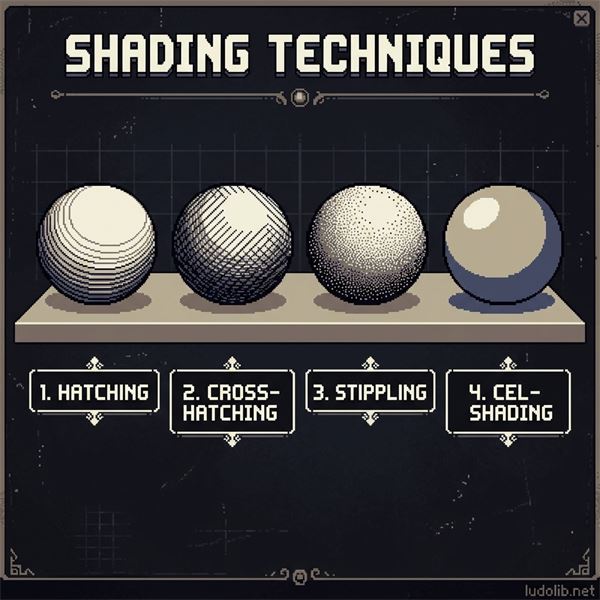 Illustration: The visual difference when applying 4 distinct shading techniques: Hatching, Cross-Hatching, Stippling, and Cel-Shading on the same base shape.
Common Shading Techniques
Below are the most prevalent methods, from classical drawing to modern digital rendering, frequently used by Game Artist and Concept Artists:
1. Hatching
- Technique: Using a series of straight (or slightly curved) parallel lines.
- Defining Form: Placing lines closer together creates darker values (Shadow), while spacing them further apart creates lighter values (Highlight).
- Application: Commonly seen in quick sketches, Manga, or games going for a pen-and-ink/pencil aesthetic (like Return of the Obra Dinn).
2. Cross-Hatching
- Technique: An evolution of Hatching. After drawing the first layer of parallel lines, the artist draws a second layer of lines overlapping the first at an angle (usually perpendicular) to create a grid pattern.
- Defining Form: The more layers of grids intersect, the darker and denser the shaded area becomes.
- Application: Excellent for achieving deep Core Shadows. Frequently used in woodcut print aesthetics or Dark Fantasy illustrations.
3. Stippling / Pointillism
- Technique: Using absolutely no lines. Instead, shading is achieved by placing countless tiny dots or specks on the surface.
- Defining Form: The denser the concentration of dots, the darker the shadow.
- Application: Very time-consuming to execute manually but creates a highly distinctive porous, textured surface. In Pixel Art, a structurally similar technique is called Dithering (covered extensively in 1-Bit Pixel Art).
4. Smooth Blending / Soft Shading
- Technique: Completely erasing the visible boundary between light and dark, creating a flawless, seamless gradient.
- Defining Form: In Digital Painting, artists achieve this by using soft-edged brushes or Smudge tools to blend values at the Terminator line.
- Application: The foundation of Realism and Semi-realism. Ideal for rendering human skin, polished metal, or smooth, glossy objects.
5. Cel-Shading / Hard Shading
- Technique: Entirely removing gradients. Shadows are rendered as hard, solid blocks of color with sharp, crisp boundaries separating the light and dark areas.
- Defining Form: Values are clustered together. Usually, only 2-3 distinct color blocks are used: Base color, Shadow, and sometimes a deep Occlusion shadow.
- Application: The backbone of Anime/Manga aesthetics, comic books, and highly stylized games like Zelda: Breath of the Wild, Genshin Impact, and Borderlands.
Connection to the Anatomy of Light
Regardless of whether an artist uses Hatching, Stippling, or Cel-shading, they must strictly adhere to the physical laws of light. This means the object must still possess a clearly identifiable Highlight, Core Shadow, Reflected Light, and Cast Shadow, as learned in the Anatomy of Light framework.
See Also
- Anatomy of Light — The theoretical framework of how light structures form.
- 1-Bit Pixel Art — The most extreme shading limitation using only 2 colors.
- PBR (Physically Based Rendering) — Realistic physical rendering (the opposite of Cel-Shading).
References
- Betty Edwards, Drawing on the Right Side of the Brain.
- Sycra Yasin, How to Draw Form and Shading.