
🎨 1-Bit Pixel Art: The Art of Absolute Limitation
Quick Summary
1-Bit Pixel Art is the most extreme aesthetic style of Pixel Art, where the entire canvas is restricted to exactly 2 colors (usually pure black and pure white, or any high-contrast monochrome pairing). Stripping away all mid-tones forces a Game Artist to rely entirely on shapes, contrast, dithering, and fluid animation to convey their message.
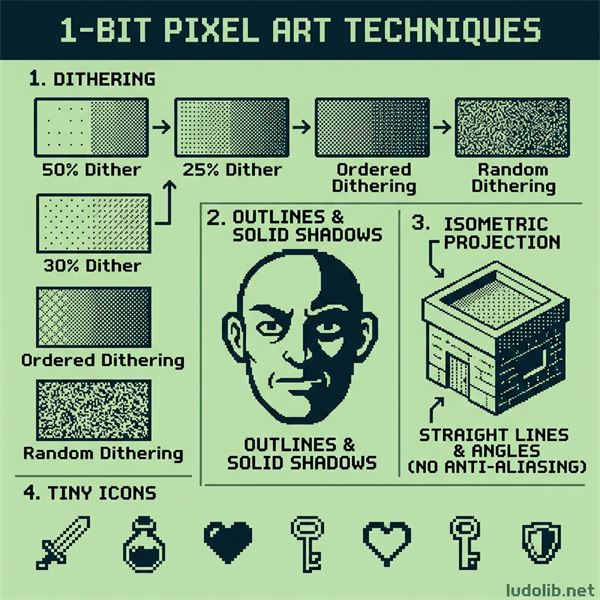 Illustration: A compilation of 1-Bit Pixel Art techniques (Dithering, Outlines, Icon design).
7 Core Rules of 1-Bit Pixel Art
Without tonal gradients to define form or lighting, 1-Bit art must adhere to strict graphical rules (based on Pedro Medeiros’s tutorials):
1. Dithering
In a 1-bit palette, you don’t have grey to transition from white to black. Dithering (interlacing pixels in specific patterns) is the only way to convey soft shadows or gradients.
- Warning: You must be extremely careful not to overdo it, or the surface will look incredibly messy. There are many ways to make these patterns (checkerboard, grids, stippling) to simulate different materials.
2. Details & Shapes
- Avoid too much detail: The fewer colors you have, the easier the image becomes noisy and cluttered.
- Use Lines: Use lines to define the big shapes and structural forms.
- Limit Solid Shadows: Use very few solid shadow blocks, as large areas of pure black will swallow the silhouette and destroy internal details.
3. Outlines
Outlines in 1-bit are crucial for separating objects from the background.
- Depending on the background, outlines can be either White or Black.
- In some cases, artists use double lines to provide extra contrast and make an object pop.
4. Watch Out for Single Pixels
One of the most common mistakes is leaving “orphan” or single pixels, especially along straight lines or curves. This creates severe “jaggies” making the art look amateurish. Artists must constantly clean up their line work.
5. The Animation Advantage
The lack of color can be perfectly compensated by motion. Because drawing a single 1-bit frame is much faster than rendering a full-color sprite, artists like to use that saved time to create very fluid animations with high frame counts. This brings immense life to the game despite the strict palette.
6. The Lack of Anti-Aliasing
Having only two colors means you cannot draw intermediate pixels to smooth out jagged edges (Anti-aliasing). Because of this harsh reality, the 1-bit style heavily favors straight lines and regular angles, making it perfect for isometric perspectives or geometric architecture.
7. Designing Tiny Icons
When forced to draw tiny icons (like a sword, potion, or heart in an 8x8 grid) using only 2 colors:
- Try to define what is the single most important and recognizable feature of that object or idea, and focus entirely on that.
- If it’s not working: Scratch it out and try something else. It is an iterative process until the human brain recognizes the silhouette without relying on color data.
See Also
- Game Art — Fundamental art concepts
- UI UX Design — Designing icons and minimalist interfaces
- Retro Game Aesthetics — The appeal of vintage limitations
References
- Pedro Medeiros (Saint11), Pixel Art Tutorials: 1-Bit Style.