
✨ Particle Effects & VFX in Games
TL;DR: Particle Effects is the technique for simulating complex phenomena (fire, smoke, rain, magic) through thousands of small particles controlled by physics and mathematical rules. This is the visual effects (VFX) layer that makes the game world feel alive and responsive to player actions.
When a fire-enchanted sword swings, you don’t just see a fire texture — you see hundreds of small particles fired in the direction of the swing, each with its own size, speed, color, and lifetime. Combined, they create the feeling of real fire, though nothing is actually “real” there. This is the art of Particle Systems.
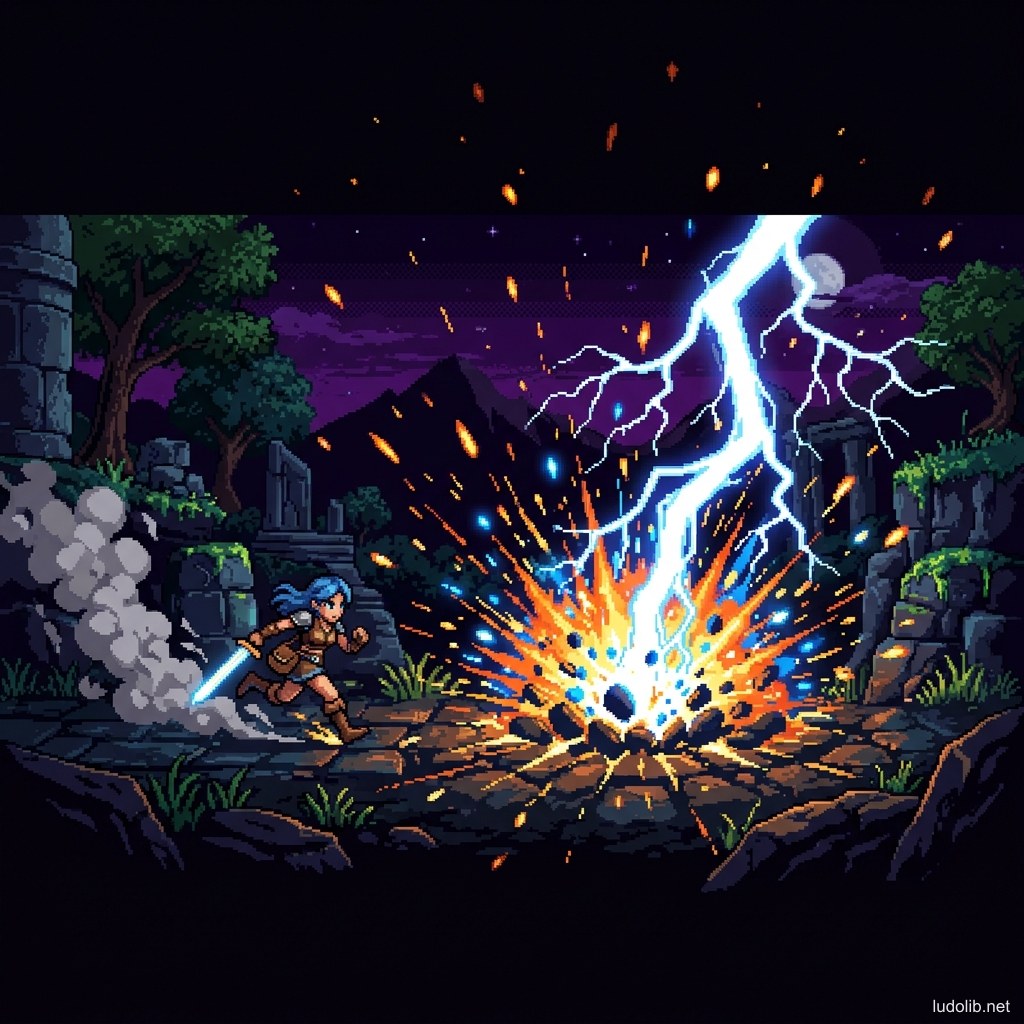
Core Concepts
Every Particle System is controlled by an Emitter (source) and particle parameters [S1]:
| Parameter | Description | Effect |
|---|---|---|
| Spawn Rate | Particles spawned per second | Small fire (few particles) vs. firestorm (many particles) |
| Lifetime | Lifespan of each particle | Short sparks vs. far-spreading smoke |
| Velocity | Initial speed and direction | Explosion scattering all directions vs. smoke rising straight up |
| Size over Life | Particle size over time | Fire large at base, shrinking as it rises |
| Color over Life | Particle color over time | Fire: white → yellow → orange → red → transparent |
| Gravity/Forces | Forces acting on particles | Smoke: upward push. Rain: downward pull |
Operating Principles
GPU Particles vs. CPU Particles
- CPU Particles: Processed on processor — more flexible, can interact with physics but limited in count (a few thousand particles) [S2].
- GPU Particles: Processed in parallel on graphics card — allows millions of simultaneous particles (full-screen rain, snow). Cannot interact with physics objects.
VFX as Gameplay Language
VFX is not just decoration — they are important feedback language [S3]:
- Hit Feedback: Blood particles/sparks when an attack hits a target — confirming a successful hit.
- Status Effects: Ring of ice particles around a frozen enemy, poison bubbles around a poisoned character.
- Environmental VFX: Falling leaves, dust rising when running through, water rippling when jumping in — creating a sense of a physically responsive world.
Juice & Game Feel
In game design, “juice” is the layer of VFX added to amplify the feel of each action. Pressing attack with good “juice”: screen shakes slightly, flash of light, particles fly from the impact point, strong “thwack” sound. Without VFX → actions feel bland. With good VFX → actions feel powerful and satisfying [S3].
Game Examples
- Hades (Supergiant Games) — Each weapon boon has its own VFX system expressing the god’s personality: Zeus (branching blue lightning), Poseidon (blue water ripples), Ares (spinning blood-red fragments). VFX aren’t just beautiful — they help identify builds instantly in combat.
- Path of Exile (Grinding Gear Games) — When players push builds to the extreme, screens contain millions of simultaneous particle effects — an aesthetic goal the community calls “screen clutter” but still loves.
- Ori and the Will of the Wisps (Moon Studios) — Every movement Ori makes leaves a particle light trail — creating the feeling that the character is a real being of light, not just a sprite on screen.
Trade-offs
| Aspect | Content |
|---|---|
| ✅ Advantages | Creates significant game feel at much lower art cost than manual keyframe animation. Particle systems can be reused with different parameters. |
| ❌ Disadvantages | Too many particles → GPU bottleneck → Frame Rate drops sharply. Especially dangerous when many effects are simultaneously on screen. |
| ⚠️ Common Pitfall | ”Particle Soup” — too many VFX simultaneously makes combat unreadable. Prioritize readability: player VFX must always be clearer than enemy VFX. |