
Isometric
Quick Summary
Isometric (Isometric Projection) is a visual technique for expressing three-dimensional space in two-dimensional flat design (2D). In video games, this property manifests as setting the camera to look down at the game environment from an angled view (typically 30 degrees) — creating a comprehensive display angle and maintaining consistent object size ratios regardless of near or far distance.
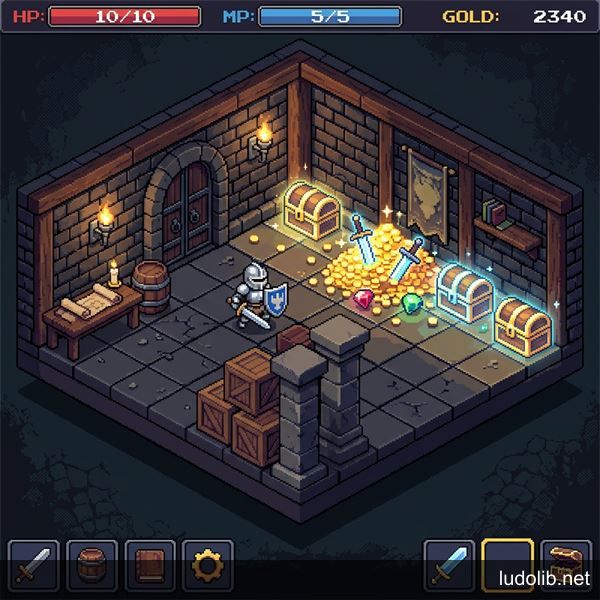 Illustration: Characteristic isometric ratio-scale graphics structure, where the interaction grid is arranged diagonally with a fixed top-down camera angle — helping players accurately judge combat distances.
The mathematical application of the Isometric structure creates a sub-layer of the 2.5D Stylized format — commonly used to solve the problem of representing 3D block forms on 2D hardware technology with many limitations of the 1990s (like Diablo, Fallout 1, or Age of Empires).
Algorithm & Graphics Mathematics Properties
The core of the Isometric image lies not in actually rotating a 3D camera, but in the system not applying “Perspective Projection.”
In real-world conditions or modern 3D simulation, objects farther from the eye appear smaller. But in the Isometric optical projection, the Scale of all displayed objects is completely locked static. A character with a height of 100 pixels when standing near the bottom edge of the screen system still has exactly 100 pixels of size when they move to the far top corner of the map. The display grid at this point is a pixel matrix (Grid) with x, y, and z axes precisely angling 120 degrees from each other on a static diamond-shaped base — creating the feeling that the player is an entity standing at an absolute observation point outside the glass screen (God View).
Mechanical Design Benefits
- High-level Interaction Precision: Thanks to the object size coefficient not being distorted by near/far distance, developers thoroughly resolve the mouse cursor navigation problem. The Click mechanism on an Isometric environment provides absolute precision in each zone — making it the ideal cornerstone in RTS strategy board game Management genres, Action Role-Playing (ARPG), or grid-based construction game simulation structures.
- Asset Management Optimization: In traditional Isometric graphics environments, model artists only need to draw one standard size for object types from a limited number of rotation angles (4 or 8 directions). These tile-sets can be reused in a Tiling structure to establish an entire vast continent from an extremely budget-saving quantity of memory files for limited production teams.