
🏺 Claymation Style in Games
TL;DR: Claymation Style simulates the aesthetic of clay animation — characters and environments carry fingerprint-textured surfaces, exaggeratedly round forms, and highly saturated colors — creating the sensation that the world was hand-molded from real clay. This is one of the most visually distinct expressions of “handcraft craftsmanship” in game graphics.
Claymation (clay + animation) has a long history in animation — famous with series like Wallace & Gromit (Aardman Animations) or the film Coraline (Laika Studios). When brought into games, this style creates a special impression — the world looks like it’s actually made from physical materials, not rendered by computer, even if in reality it’s entirely 3D.
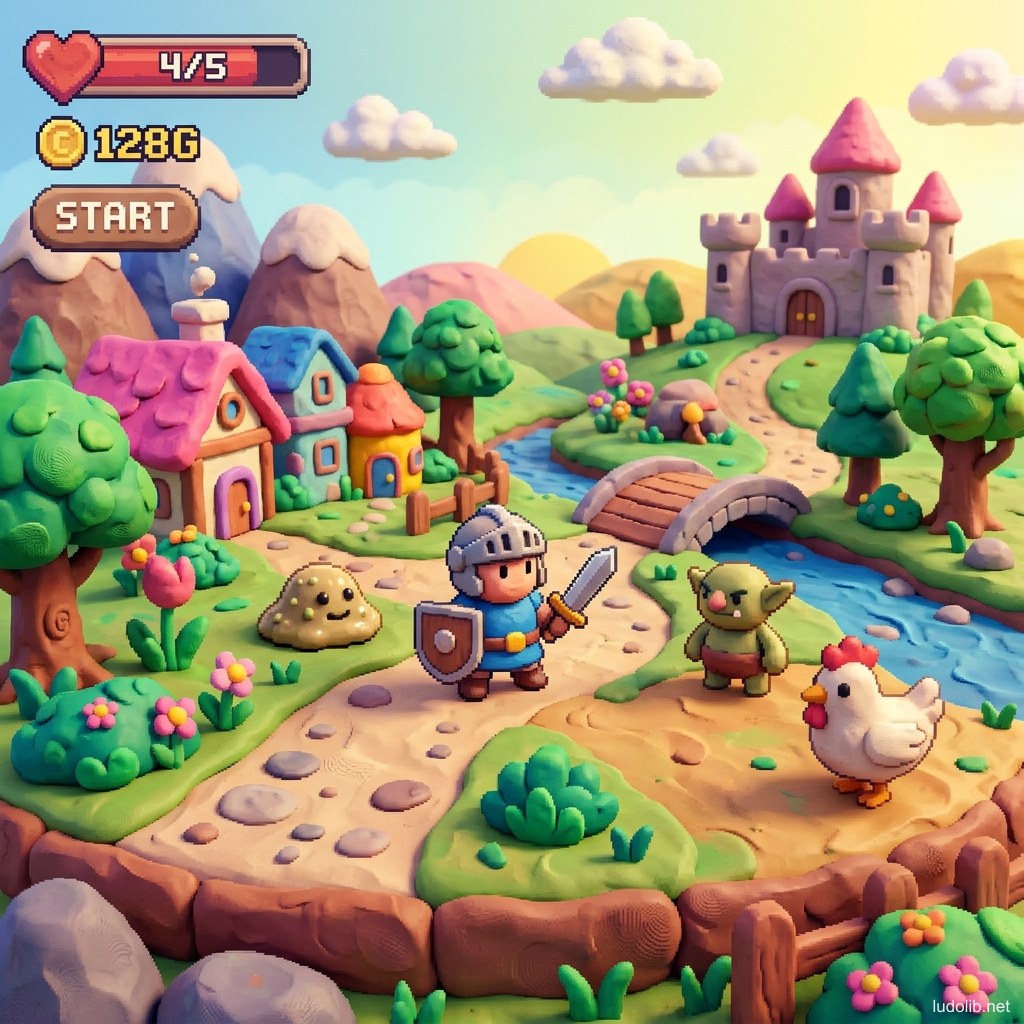
Core Concepts
| Element | Characteristic | How to Create in 3D |
|---|---|---|
| Clay Texture | Fingerprinted surface, imperfect, matte | Slight subsurface scattering + fingerprint normal map |
| Rounded Forms | All sharp edges are rounded — no naturally sharp corners | High subdivision + crease edge reduction |
| Smear Frames | Elongating shape in movement direction — classic animation trick | Stylized motion blur |
| Stop-Motion Jitter | Slightly jerky movement, not completely linear | Frame stepping, slight position randomization |
| Saturated Palette | Vivid, deep colors — like real physical clay | HSV boost + limited palette |
| Warm Diffuse Lighting | Soft light, no sharp shadows — like stop-motion studio lamp | Area light, no hard shadows |
Operating Principles
Claymation Simulation Techniques in 3D
Rather than actually using clay (expensive and hard to scale), modern studios create Claymation through 3D techniques with these tricks [S1]:
Clay Shader: Specialized shader combining:
- Matte diffuse (no sharp specular)
- Slight subsurface scattering (light penetrating material lightly — like real clay)
- Normal map fingerprint texture
Smear Deformation: Animation technique exaggerating mesh deformation when moving fast — making animation look like real clay being stretched, not rigid polygons moving.
Post-process: Apply light grain and slight color bleed between adjacent objects.
Claymation vs. Cartoon 3D
| Element | Claymation | Cel-Shading |
|---|---|---|
| Surface texture | Matte, textured | Flat color, no texture |
| Outline | None (or very faint) | Clear black outline |
| Lighting | Soft, diffuse | Hard tonal step |
| Movement | Slight jitter | Smooth or stylized |
Game Examples
- Armikrog (Pencil Test Studios, 2015) — Game actually made with physical clay and stop-motion — no 3D. The purest claymation game, though extremely costly.
- ClayFighter (Interplay, 1993) — Fighting game using digitized clay models photographed in reality — pioneered this style in games.
- Skullgirls (Lab Zero Games, 2012) — Not pure claymation, but animation smear frames and exaggerated deformation inspired by clay animation.
Trade-offs
| Aspect | Content |
|---|---|
| ✅ Advantages | Extremely unique and memorable — few games use this style. Warm, fun, non-threatening feeling — suitable for children or casual games. |
| ❌ Disadvantages | Hard to maintain consistency when scaling to many assets. Stop-motion jitter and smear frames must be carefully designed or they look like animation errors. |
| ⚠️ Common Pitfall | ”Plastic look” — if the shader lacks SSS (subsurface scattering) and the normal map is rough, clay looks like shiny plastic rather than matte clay. Material is the key differentiator. |