
🗺️ Tilemaps
Quick Summary
Tilemaps are a 2D world-building technique that decomposes large game environments into a grid matrix. Instead of loading a single enormous image, the system uses a set of small reusable tile images (Tiles) arranged and repeated in different configurations to construct the game world. This is the core solution for building large 2D worlds while conserving hardware resources.
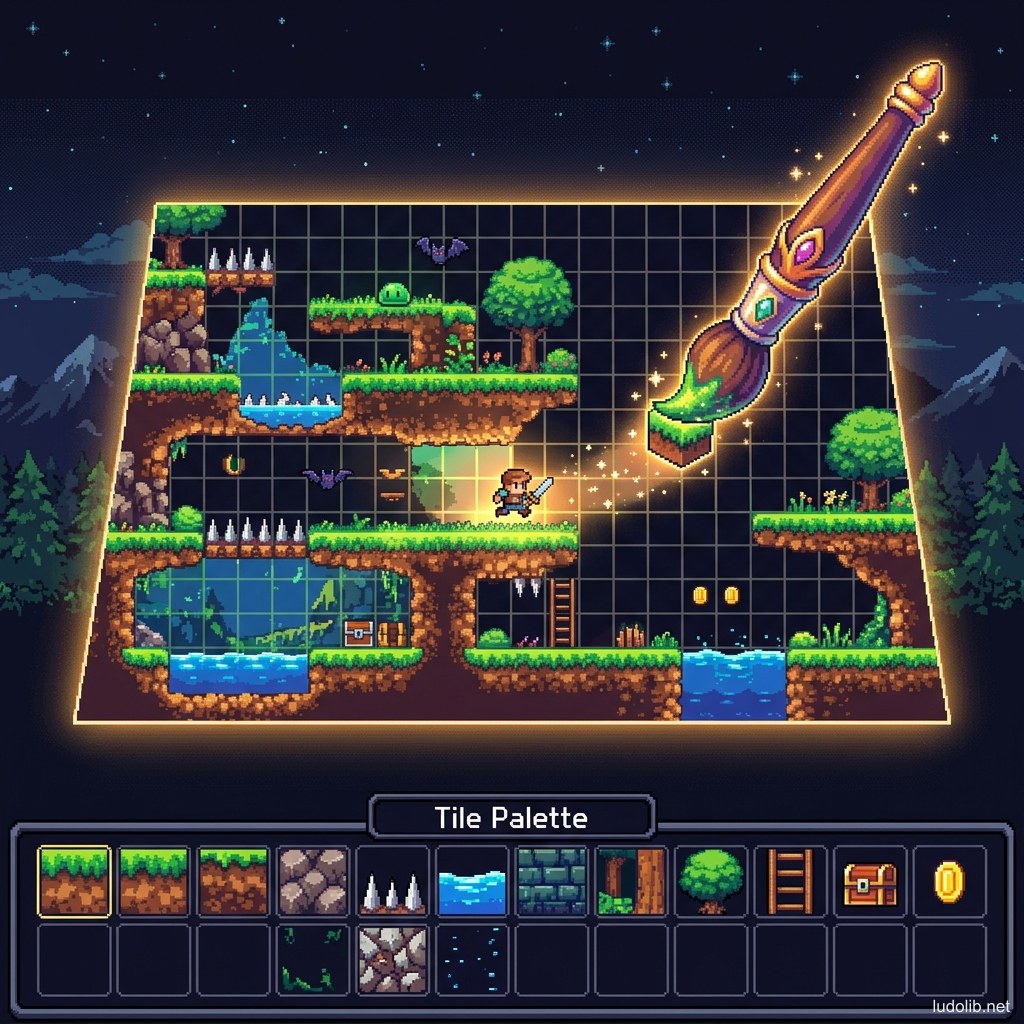
The Grid-Based Rendering Principle
If Sprite Renderer solves the problem of rendering dynamic entities (characters, enemies), Tilemaps solves the problem of constructing static environment landscapes (Level Design).
The Memory Problem: In 2D Open World games, the environment can extend seemingly infinitely. Rendering a single image file of pixels is completely infeasible — it would immediately cause memory overflow.
The Tilemap Solution: The graphics system is converted to a data table format:
- Tileset: A small image file containing basic material tiles (e.g., a pixel dirt tile, a grass tile, a stone tile).
- Tile Palette: The editor provides tools for designers to “paint” these material tiles onto a grid plane.
- Tilemap Component: At runtime, the computer doesn’t load a landscape image. It reads a small text file of coordinate structures. Example:
Coordinate (0,0) = ID 1 (Grass); Coordinate (0,1) = ID 2 (Dirt). The engine references this data to call images from the Tileset and display them on screen.
Optimization Capability
The grid-based caching technique of Tilemaps enables games like Terraria and Stardew Valley to build map systems spanning tens of thousands of square kilometers while keeping storage size to just a few Megabytes.
Modern Tilemap systems also support Rule Tiles (connection rules). Tiles automatically change their border images based on adjacent tiles — making level design fully automated without programmer intervention. This technique defined the development standard of the 8-bit and 16-bit era and continues as the backbone of modern 2D game engines.