
🛒 Asset Market
Quick Summary
Asset Market (Asset Store Hub) refers to commercial digital marketplaces integrated with — or linked to — game engines. These are B2B/B2C platforms where developers buy and sell pre-made game components (3D models, code plugins, audio, effects) to reduce development time and cost.
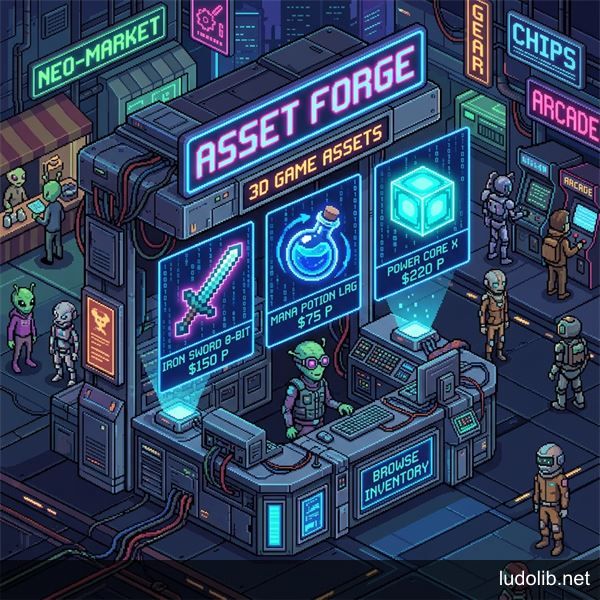 Illustration: The structural diagram of an Asset Store, where technical components like source code, blueprints, and audio files are standardized for commercial packaging.
Asset Categories
Asset markets provide comprehensive data architecture for nearly every production phase:
- Scripts & Plugins: Controller templates, Inventory Systems, C# or C++ code blocks extending platform algorithms.
- 3D/2D Assets: Optical mesh structures, landscape polygon setups, pre-rendered animations, or 2D Sprite packs.
- VFX & Shaders: Render code for fire surface structures, weather interactions, or water reflections.
- Audio/SFX: Standardized environmental sound effects and background music.
Major Asset Platforms
| Platform | Focus | Notes |
|---|---|---|
| Unity Asset Store | General indie/mid-tier | World’s largest and most diverse asset repository |
| Unreal Engine Marketplace (Fab) | High-end realistic assets | Cinematic-quality assets; Megascans integration |
| Itch.io | Game Jam culture, 2D/free | Free and CC0 asset hub for indie developers |
| Sketchfab | 3D model marketplace | High-poly 3D for games and CGI animation |
| Kenney | Free modular prototyping | ”Public Domain” — 100% CC0 free art assets |
The Asset Flipping Problem
The rise of asset markets lowered the barrier to entry for game development — a designer with no art skills can publish a game by assembling purchased assets. However, this directly enabled Asset Flipping: buying a game template from the asset store, renaming it, and immediately releasing it on Steam without adding any original creative value.
This practice has led to significant player criticism for software spam flooding distribution platforms.
See also: Game Monetization Models, Valve, Distribution Platforms