
📜 Narrative Pipeline
Quick Summary
Narrative Pipeline is the architectural system managing the flow of story content from initial concept sketches to final post-production voiceover implementation. It is the critical backbone where Narrative Designers, Game Artists, and Programmers synchronize assets to ensure a seamless narrative experience.
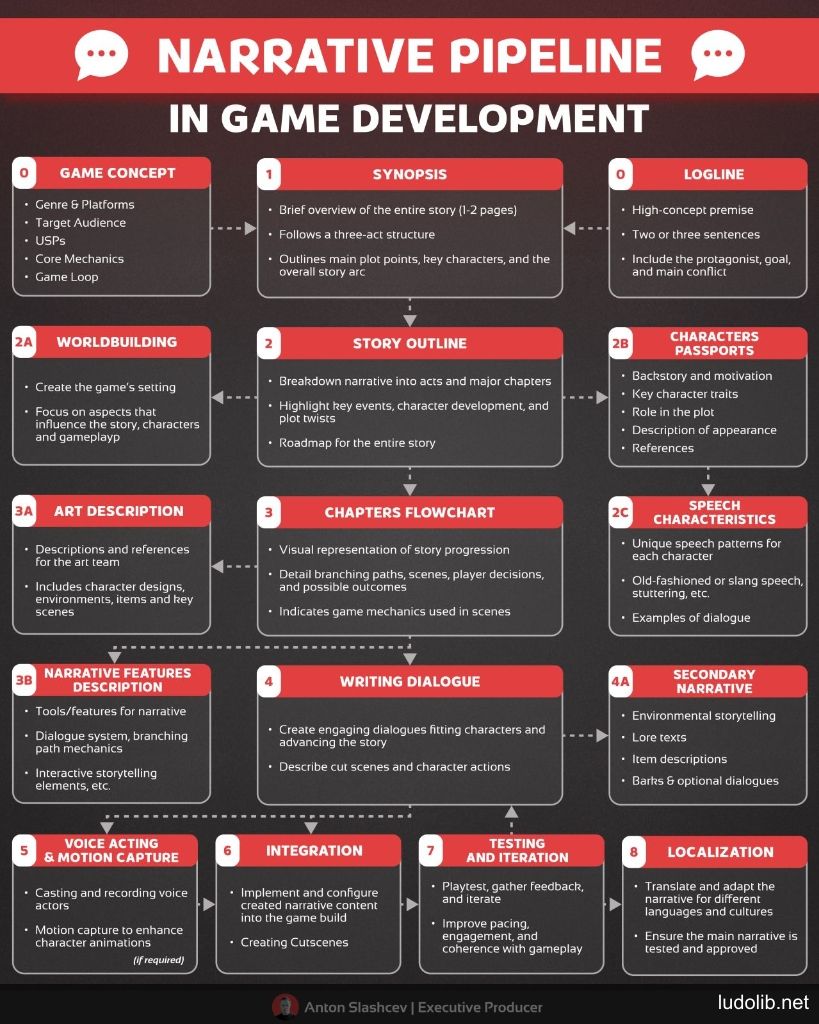
Phase 1: Foundation (Pre-Production & Concept)
Every initial draft must serve the core gameplay loop.
- Worldbuilding & Lore Bible: Establishing the rules of the universe, history, and character motivations.
- High-Level Beat Sheet: Mapping the critical story events to the game’s level progression.
Phase 2: Content Creation (Production)
The heaviest collaboration phase where writing becomes interactive data.
- Scripting & Branching: Writing dialogue trees in tools like Twine or articy:draft.
- Casting & Voice Over (VO) Recording: Auditioning actors and recording lines.
- Cinematics & Mocap: Motion capture sessions and cutscene animation.
Phase 3: Integration (Implementation)
Putting the pieces together in the engine.
- Logic Hookup: Connecting dialogue audio files to in-game triggers (e.g., line plays when player crosses an invisible boundary).
- Localization: Translating the script into multiple languages and ensuring UI text boxes don’t break.
- Narrative QA: Testing every dialogue branch to ensure logic flags work (e.g., NPC doesn’t reference an event that hasn’t happened yet).
The Non-Linear Challenge
Unlike a movie script, a game narrative pipeline must account for iteration. If a Level Designer cuts a room from the game for pacing reasons, the Narrative team must rewrite the dialogue that was supposed to happen in that room, which then requires re-recording the voice actor, re-animating the lip-sync, and re-testing the logic flags.