
🧰 Gamedev Tools (Development Ecosystem)
Quick Summary
Gamedev Tools encompass the entire software infrastructure integrated to serve the design, production, testing, and distribution of a game. This ecosystem ranges from macro project management to micro texture rendering tools, playing a vital role in standardizing and scaling a project.
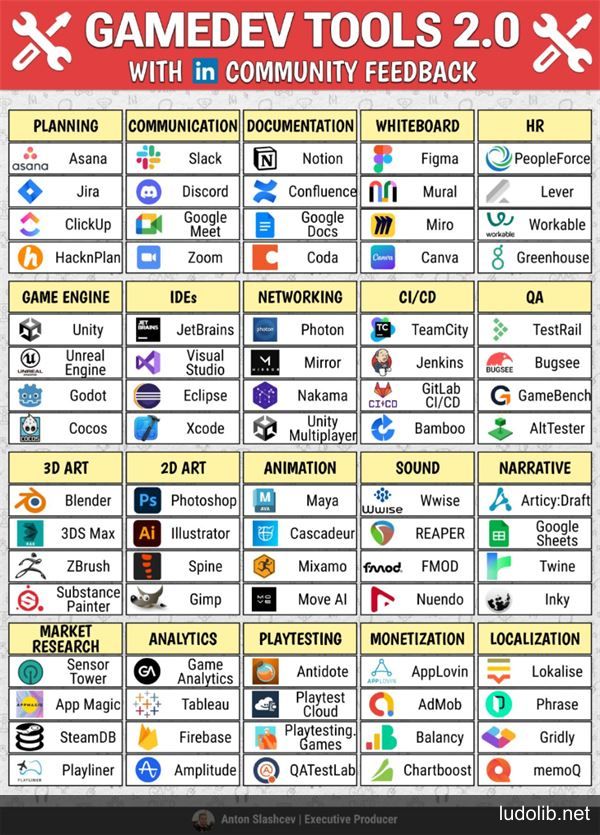
Building an interactive entertainment product requires the convergence of dozens of distinct disciplines. A modern industry-standard pipeline organizes its tools into four technical categories:
1. Management & Operations
The foundational layer responsible for tracking progress, storing internal knowledge, and routing communication.
- Task Tracking: Jira, Trello, Asana
- Documentation: Confluence, Notion, Obsidian/Quartz
- Communication: Slack, Discord, Microsoft Teams
2. Source Control & Versioning
Because hundreds of developers edit the same codebase and assets simultaneously, version control prevents catastrophic overwrites and tracks every historical change.
- Code: Git (GitHub, GitLab, Bitbucket)
- Large Assets: Perforce (Industry standard for heavy binary files like 3D models and textures), Plastic SCM
3. Content Creation (DCC Tools)
Digital Content Creation software where the actual art and audio assets are manufactured.
- 3D & Animation: Maya, Blender, ZBrush
- Texturing: Substance Painter, Photoshop
- Audio: Pro Tools, Reaper
- UI: Figma
4. The Engine & Middleware
The central hub where all assets are assembled, scripted, and compiled into the final executable product.
- Game Engines: Unreal Engine, Unity, Godot, or Proprietary Engines
- Audio Middleware: Wwise, FMOD
- Physics Middleware: Havok